
When diagnosed with diabetes, one of the first questions many people ask is:
“Can I still eat fruit?”
The answer is yes—but choosing the right fruit and eating the right portion makes all the difference.
Among the many fruits available during summer, peaches and plums are two delicious options that often leave people wondering which one is better for blood sugar control. Both are naturally sweet, rich in vitamins, and packed with antioxidants. However, they differ in calories, carbohydrates, natural sugar, glycemic load, and other nutrients that can influence blood glucose levels.
So, in the debate of Peach Vs Plum, which fruit deserves a place on your diabetic meal plan?
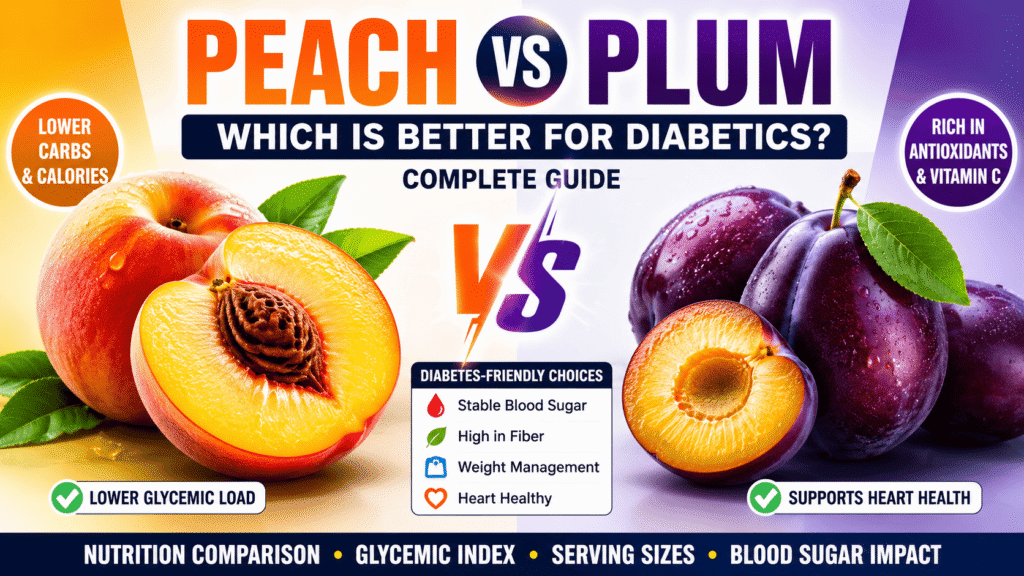
The answer isn’t as simple as choosing one over the other. Instead, understanding how each fruit affects your body will help you make smarter dietary decisions.
In this comprehensive guide, we will compare peaches and plums from every important angle—including nutrition, carbohydrates, fiber, vitamins, glycemic index (GI), glycemic load (GL), portion sizes, and their overall effect on blood sugar.
By the end of this article, you’ll know exactly which fruit is safer, healthier, and more suitable for people living with diabetes.
Table of Contents
Why Fruit Choice Matters in Diabetes
Many people mistakenly believe that all fruits are equally healthy because they are natural.
While fruits certainly provide vitamins, minerals, antioxidants, and dietary fiber, they also contain natural sugars and carbohydrates. These carbohydrates eventually break down into glucose, raising blood sugar levels.
The key difference lies in how quickly and how much they raise blood glucose.
Several factors determine a fruit’s effect on blood sugar, including:
- Total carbohydrate content
- Natural sugar content
- Dietary fiber
- Water content
- Glycemic Index (GI)
- Glycemic Load (GL)
- Serving size
This is why diabetes management is not about avoiding fruit altogether—it’s about choosing fruits wisely and controlling portions.
A medium peach and a handful of plums may have similar calories, but their impact on blood sugar can still differ.
Understanding these differences empowers you to enjoy fruit without unnecessary spikes in blood glucose.
Peach Vs Plum: Quick Comparison
Before diving into the detailed analysis, here’s a quick overview.
| Nutrient (100 g) | Peach | Plum |
| Calories | 39 kcal | 46 kcal |
| Carbohydrates | 9.5 g | 11.4 g |
| Natural Sugar | 8.4 g | 9.9 g |
| Fiber | 1.5 g | 1.4 g |
| Protein | 0.9 g | 0.7 g |
| Potassium | 190 mg | 157 mg |
| Vitamin C | 6.6 mg | 9.5 mg |
| Water | 89% | 87% |
| Glycemic Index | 42 | 40 |
| Glycemic Load | 4 | 5 |
At first glance, both fruits appear very similar. However, the small nutritional differences become more meaningful when you consider blood sugar management, portion size, and total daily carbohydrate intake.
Let’s explore each nutrient in detail.
Peach Vs Plum Nutrition Comparison (Per 100 Grams)
Nutrition labels often look similar, but small differences can have a meaningful impact when planning meals for diabetes.
Peach Nutrition (100 g)
- Calories: 39 kcal
- Carbohydrates: 9.5 g
- Natural Sugar: 8.4 g
- Fiber: 1.5 g
- Protein: 0.9 g
- Fat: 0.3 g
- Potassium: 190 mg
- Vitamin C: 6.6 mg
- Water: 89%
Plum Nutrition (100 g)
- Calories: 46 kcal
- Carbohydrates: 11.4 g
- Natural Sugar: 9.9 g
- Fiber: 1.4 g
- Protein: 0.7 g
- Fat: 0.3 g
- Potassium: 157 mg
- Vitamin C: 9.5 mg
- Water: 87%
Although these values seem close, even a difference of 2 grams of carbohydrates per 100 grams can become significant if larger portions are consumed.
Calories: Which Fruit Is Better?
People with diabetes often focus solely on sugar, but calorie intake also matters.
Maintaining a healthy body weight improves insulin sensitivity and reduces the risk of complications such as heart disease, fatty liver, and hypertension.
A peach contains only 39 calories per 100 grams, while plums provide approximately 46 calories.
This difference may seem small, but over time it contributes to total daily calorie intake.
If you’re following a calorie-controlled meal plan for weight loss or blood sugar management, peaches offer a slight advantage.
Winner: Peach
Carbohydrates: The Most Important Number for Blood Sugar
When comparing fruits for diabetes, carbohydrates matter more than sweetness.
Every gram of digestible carbohydrate has the potential to increase blood glucose.
Per 100 grams:
- Peach: 9.5 g carbohydrates
- Plum: 11.4 g carbohydrates
That means plums contain roughly 20% more carbohydrates than peaches.
For someone counting carbohydrates throughout the day, this difference becomes important.
Suppose you eat:
- One peach
- Three peaches
- Five peaches
Now compare that with the same weight of plums.
The carbohydrate difference grows larger with every serving.
This is one reason why peaches often produce a slightly lower glycemic load than plums.
If your goal is to keep carbohydrate intake lower while still enjoying fruit, peaches have a small nutritional advantage.
Natural Sugar Comparison
People often ask:
“Which fruit has less sugar?”
The answer is peaches.
Natural sugar per 100 grams:
Peach: 8.4 g
Plum: 9.9 g
Although both contain naturally occurring fruit sugars rather than added sugar, total sugar still contributes to blood glucose.
However, it’s important to remember that whole fruits are much healthier than sugary drinks or desserts because they also contain fiber, vitamins, minerals, and antioxidants.
The presence of fiber slows sugar absorption and reduces rapid spikes in blood glucose.
Therefore, focusing only on sugar grams without considering fiber and glycemic load can be misleading.
Fiber: Nature’s Blood Sugar Protector
Fiber is one of the most valuable nutrients for people with diabetes.
Unlike digestible carbohydrates, fiber is not rapidly converted into glucose.
Instead, it helps by:
- Slowing stomach emptying
- Delaying glucose absorption
- Improving satiety
- Supporting gut health
- Reducing post-meal blood sugar spikes
- Helping lower cholesterol
Fiber content per 100 grams:
- Peach: 1.5 g
- Plum: 1.4 g
The difference is minimal.
Both fruits provide modest amounts of dietary fiber, making them healthier than fruit juices or processed snacks.
To maximize the fiber benefit, always eat peaches and plums with their edible skin whenever possible.
Removing the skin reduces the total fiber available.
Protein and Fat Comparison
Neither peaches nor plums are significant sources of protein or healthy fats.
Peach:
- Protein: 0.9 g
- Fat: 0.3 g
Plum:
- Protein: 0.7 g
- Fat: 0.3 g
Because protein and fat help slow digestion, nutrition experts often recommend pairing fruit with a protein-rich snack such as:
- Plain Greek yogurt
- Cottage cheese
- A handful of almonds
- Walnuts
- Pistachios
- Unsweetened peanut butter
Combining fruit with protein can reduce the rise in blood sugar compared with eating fruit alone.
Vitamins and Minerals: Which Fruit Offers More Nutrition?
Although both fruits are nutritious, each has its own strengths.
Peach: Richer in Potassium
Peaches provide approximately 190 mg of potassium per 100 grams.
Potassium is important for:
- Healthy blood pressure
- Muscle function
- Nerve signaling
- Heart rhythm
- Fluid balance
People with diabetes often have an increased risk of hypertension, making potassium-rich foods beneficial for overall cardiovascular health.
Plum: Higher in Vitamin C
Plums contain approximately 9.5 mg of Vitamin C, compared with 6.6 mg in peaches.
Vitamin C supports:
- Immune function
- Collagen production
- Wound healing
- Antioxidant protection
- Healthy skin
- Reduced oxidative stress
Since diabetes is associated with increased oxidative stress, consuming antioxidant-rich fruits may provide additional health benefits.
Rather than viewing one fruit as universally superior, it’s more accurate to recognize that peaches and plums each contribute unique nutrients to a balanced diet.
Hydration Benefits During Summer
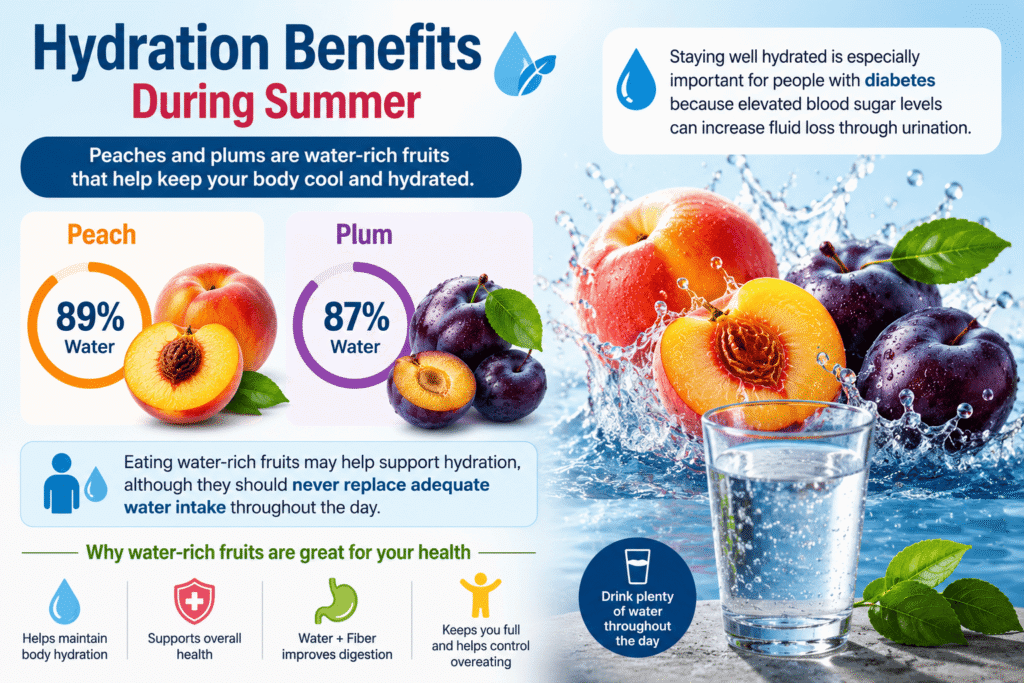
Both peaches and plums have a high water content, making them excellent fruits for hot weather.
- Peach: 89% water
- Plum: 87% water
Staying well hydrated is especially important for people with diabetes because elevated blood sugar levels can increase fluid loss through urination.
Eating water-rich fruits may help support hydration, although they should never replace adequate water intake throughout the day.
In addition to hydration, the combination of water and fiber can increase feelings of fullness, potentially reducing overeating.
What Do These Numbers Mean for People with Diabetes?
Looking at nutrition labels alone can be confusing.
A difference of just a few grams of carbohydrate or a few calories may seem insignificant.
However, diabetes management is about the overall pattern of eating, not a single food.
From the nutritional comparison, several practical observations emerge:
- Peaches are slightly lower in calories, making them a better option for people aiming to lose weight or reduce calorie intake.
- Peaches contain fewer carbohydrates and less natural sugar, which may contribute to a smaller blood glucose response when portions are equal.
- Plums provide more vitamin C and powerful antioxidants, making them an excellent choice for immune support and reducing oxidative stress.
- Both fruits contain similar amounts of fiber, helping slow sugar absorption and improve satiety.
- Both are naturally hydrating, making them refreshing summer fruits.
The most important takeaway is that both peaches and plums can fit into a diabetes-friendly diet when eaten in appropriate portions. The key is not simply choosing the fruit with the lower numbers but understanding how serving size, meal composition, and total daily carbohydrate intake influence blood sugar.
Understanding Glycemic Index (GI)
One of the most common terms people hear when discussing diabetes is the Glycemic Index (GI). But what does it actually mean?
The Glycemic Index is a ranking system that measures how quickly a carbohydrate-containing food raises blood glucose levels compared with pure glucose.
Foods are generally classified into three categories:
| GI Range | Classification |
| 55 or less | Low GI |
| 56–69 | Medium GI |
| 70 or above | High GI |
Low-GI foods are digested more slowly, leading to a gradual rise in blood sugar. This makes them a better choice for people with diabetes.
However, GI tells only part of the story. It does not consider how much carbohydrate is present in a typical serving. That’s where Glycemic Load becomes more useful.
Peach Vs Plum Glycemic Index
Both peaches and plums belong to the low-GI fruit category.
| Fruit | Glycemic Index |
| Peach | 42 |
| Plum | 40 |
The difference is very small.
Technically, plums have a slightly lower Glycemic Index than peaches, but the difference is unlikely to make a noticeable impact in everyday eating.
This means that both fruits release glucose into the bloodstream gradually rather than causing a rapid spike.
For people managing diabetes, this is excellent news.
Why Glycemic Load Is More Important Than GI
Many people focus only on the Glycemic Index, but diabetes experts often consider Glycemic Load (GL) a more practical measurement.
Why?
Because Glycemic Load takes into account:
- The Glycemic Index
- The amount of carbohydrates in a serving
The formula is:
GL = (GI × Available Carbohydrates) ÷ 100
This gives a much better picture of how a realistic portion of food affects blood sugar.
Glycemic Load Categories
| GL | Classification |
| 10 or less | Low |
| 11–19 | Medium |
| 20 or more | High |
Since peaches contain fewer carbohydrates than plums, they usually have a slightly lower Glycemic Load despite having a marginally higher GI.
This is why Glycemic Load is often a better tool for meal planning.
Peach Vs Plum Glycemic Load
For a standard 100-gram serving, the Glycemic Load is approximately:
| Fruit | GI | Carbohydrates | GL |
| Peach | 42 | 9.5 g | 4 |
| Plum | 40 | 11.4 g | 5 |
Both values fall within the low Glycemic Load range, meaning they have only a modest effect on blood sugar when eaten in reasonable portions.
However, portion size matters.
Let’s see what happens as the serving size increases.
Blood Sugar Impact at Different Serving Sizes
Many people assume that if a food has a low Glycemic Index, they can eat unlimited amounts. Unfortunately, that isn’t true.
Even healthy fruits can raise blood sugar when consumed in large quantities.
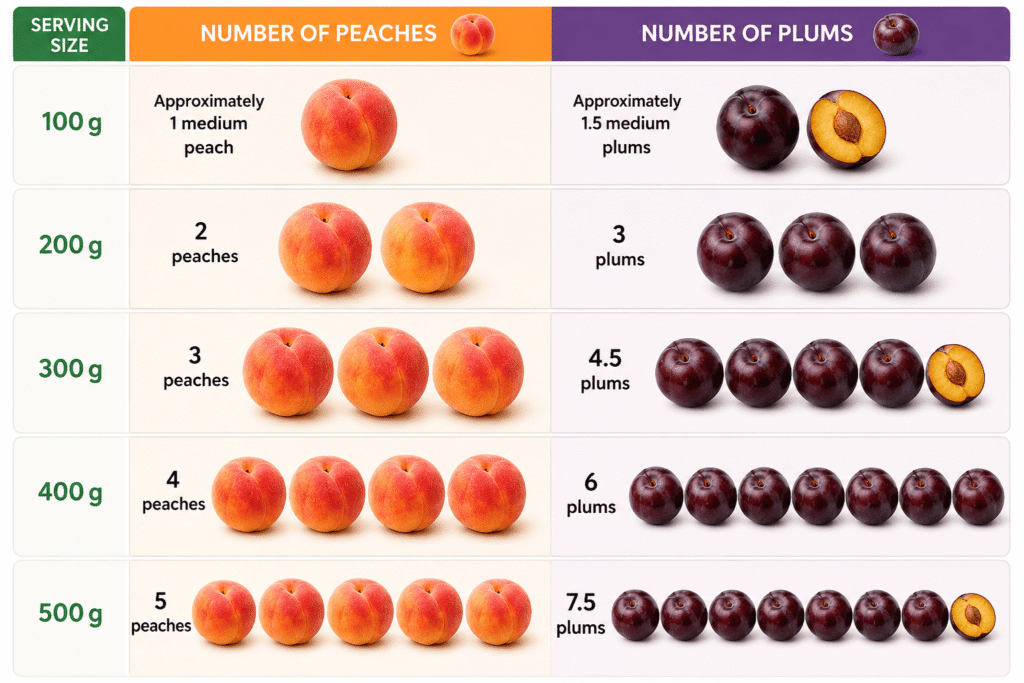
Below is a comparison of peaches and plums at different serving sizes.
100 Grams: A Diabetes-Friendly Portion
Approximately:
- 1 medium peach
- 1½ medium plums
Peach
- Carbohydrates: 9.5 g
- Glycemic Load: 4
Plum
- Carbohydrates: 11.4 g
- Glycemic Load: 5
At this serving size, both fruits are considered excellent choices for people with diabetes.
Blood sugar usually rises slowly because both the carbohydrate content and Glycemic Load remain low.
Winner: Both are safe.
200 Grams: Still a Reasonable Choice
Approximately:
- 2 peaches
- 3 plums
Peach
- Carbohydrates: 19 g
- GL: 8
Plum
- Carbohydrates: 22.8 g
- GL: 9
This serving is still within the low Glycemic Load range.
However, people with diabetes should begin considering the carbohydrate content of the rest of the meal.
If eaten together with yogurt, nuts, or another source of protein, the blood sugar response may be even more gradual.
300 Grams: Moderate Blood Sugar Effect
Approximately:
- 3 peaches
- 4 plums
Peach
- Carbohydrates: 28.5 g
- GL: 12
Plum
- Carbohydrates: 34.2 g
- GL: 14
Now the Glycemic Load enters the medium range.
Although still acceptable for many individuals, this amount may produce a more noticeable rise in blood glucose, especially if eaten alone.
Portion control becomes increasingly important.
400 Grams: Portion Control Is Essential
Approximately:
- 4 peaches
- 6 plums
Peach
- Carbohydrates: 38 g
- GL: 16
Plum
- Carbohydrates: 45.6 g
- GL: 18
At this level, both fruits contribute a substantial amount of carbohydrates.
For people with diabetes, eating this quantity in one sitting is generally not recommended unless it fits within a carefully planned meal.
500 Grams: Significant Blood Sugar Impact
Approximately:
- 5 peaches
- 7–8 plums
Peach
- Carbohydrates: 47.5 g
- GL: 20
Plum
- Carbohydrates: 57 g
- GL: 23
At this point, both fruits enter the high Glycemic Load range.
Although they remain healthy fruits, consuming half a kilogram in one sitting can significantly increase blood sugar.
Plums have a greater impact because they contain more total carbohydrates.
This demonstrates an important lesson:
Even healthy foods can become unhealthy when the portion size becomes excessive.
Why Portion Size Matters More Than Fruit Choice
Many people ask:
“Should I avoid peaches?”
Others ask:
“Are plums bad for diabetes?”
The better question is:
“How much am I eating?”
Whether you choose peaches or plums, the quantity you consume has a far greater influence on blood glucose than the small nutritional differences between the two fruits.
For most adults with diabetes:
- One medium peach
- Two medium plums
are generally easier to fit into a balanced meal than several large servings eaten at once.
This is why diabetes management focuses on portion control, not complete restriction.
Antioxidants: An Advantage of Plums
While peaches contain fewer carbohydrates, plums offer another important health benefit.
Plums are rich in anthocyanins and polyphenols, two powerful plant compounds that act as antioxidants.
Research suggests these antioxidants may help:
- Reduce oxidative stress
- Lower inflammation
- Protect blood vessels
- Support heart health
- Improve metabolic health
- Reduce cellular damage caused by free radicals
Since diabetes increases oxidative stress throughout the body, antioxidant-rich foods can be valuable as part of an overall healthy eating pattern.
This gives plums an important nutritional advantage beyond blood sugar control.
Peaches: A Better Choice for Weight Management?
Peaches contain:
- Fewer calories
- Less carbohydrate
- Less natural sugar
- More potassium
- Slightly more water
These characteristics make peaches particularly appealing for people trying to:
- Lose weight
- Reduce calorie intake
- Improve hydration
- Manage blood pressure
- Lower overall carbohydrate intake
Although the differences are modest, they become meaningful when fruit is eaten regularly.
Fresh Fruit vs Fruit Juice
One of the biggest mistakes people with diabetes make is turning healthy fruit into juice.
When fruit is juiced:
- Much of the fiber is removed.
- The sugar becomes more concentrated.
- It is easier to consume several servings at once.
- Blood sugar rises much more rapidly.
For example, one glass of peach juice may contain the sugar from three or four peaches, yet it provides much less fiber.
The same applies to plum juice.
Whenever possible, choose whole fresh fruit instead of juice.
Your blood sugar—and your digestive system—will thank you.
Best Time to Eat Peaches and Plums
Although there is no perfect time, certain strategies may help improve blood sugar control.
Good options include:
- As part of breakfast with protein
- Mid-morning snack
- Afternoon snack
- After exercise
- As dessert after a balanced meal
Avoid eating large amounts of fruit:
- On an empty stomach if you notice blood sugar spikes
- Late at night in large portions
- Together with sugary desserts
Pairing fruit with:
- Greek yogurt
- Cottage cheese
- Almonds
- Walnuts
- Pistachios
can slow digestion and improve satiety.
Common Mistakes People with Diabetes Make
Many people unintentionally increase their blood sugar because of simple mistakes.
Eating Unlimited Fruit
Natural does not mean unlimited.
Drinking Fruit Juice
Juice removes much of the beneficial fiber.
Ignoring Portion Size
Even low-GI foods can become high-GL meals if consumed excessively.
Fruit alone may cause a larger blood sugar rise than fruit paired with protein.
Choosing Dried Fruit Instead of Fresh
Dried plums (prunes) contain much more concentrated sugar than fresh plums.
Practical Tips for Enjoying Peaches and Plums Safely
If you have diabetes, these simple habits can help:
- Choose fresh, whole fruit whenever possible.
- Keep portions moderate.
- Eat fruit with meals or alongside a source of protein.
- Avoid fruit juices and sweetened canned fruits.
- Include fruit within your daily carbohydrate allowance.
- Monitor your blood sugar if you’re trying a new fruit or a larger serving size.
- Remember that individual responses to food can vary.
Frequently Asked Questions (FAQs)
Can people with diabetes eat peaches?
Yes. Peaches are considered a low-GI fruit and can be enjoyed in moderation as part of a balanced diet.
Are plums safe for diabetics?
Yes. Fresh plums are generally diabetes-friendly when eaten in appropriate portions.
Which fruit contains less sugar?
Peaches contain slightly less natural sugar than plums.
Which fruit has the lower Glycemic Index?
Plums have a slightly lower GI (40) compared with peaches (42), but the difference is very small.
Which fruit has the lower Glycemic Load?
Peaches have the lower Glycemic Load because they contain fewer carbohydrates per serving.
Can I eat peaches or plums every day?
Most people with diabetes can include these fruits regularly, provided they are consumed in moderation and as part of an overall balanced meal plan.
Final Verdict: Peach Vs Plum for Diabetes
After comparing nutrition, carbohydrates, natural sugars, fiber, Glycemic Index, Glycemic Load, antioxidants, and serving sizes, it becomes clear that both peaches and plums are healthy fruit choices for people with diabetes.
If your primary goal is keeping carbohydrate intake and Glycemic Load as low as possible, peaches have a slight advantage. They contain fewer calories, less natural sugar, fewer carbohydrates, and a lower Glycemic Load, making them an excellent option for blood sugar management and weight control.
However, plums should not be overlooked. Their rich supply of vitamin C, anthocyanins, and polyphenols makes them a valuable addition to a diabetes-friendly diet, particularly for supporting heart health and reducing oxidative stress.
Ultimately, the healthiest choice is not determined by the fruit alone but by how much you eat. A moderate portion of either fruit can fit comfortably into a well-balanced diabetes meal plan.
Instead of asking, “Which fruit is better?”, a more useful question is, “Am I eating the right portion?”
By focusing on portion control, pairing fruit with protein or healthy fats, and choosing whole fruits over juice, you can enjoy the natural sweetness of peaches and plums while maintaining healthy blood sugar levels.