
What you eat for breakfast matters when you have diabetes—but how much you eat can matter just as much.
A breakfast that looks completely normal may contain far more carbohydrates than you realize. A large paratha, two slices of white bread, sweet lassi, a generous bowl of cornflakes, or several rusks can quickly add up to a substantial carbohydrate load.
This is where diabetes breakfast portion size becomes important.
Portion control does not mean that every favorite food has to disappear from your breakfast table. In many cases, the more practical approach is to look at the serving size, carbohydrate content, glycemic index (GI), and glycemic load (GL) of the food.
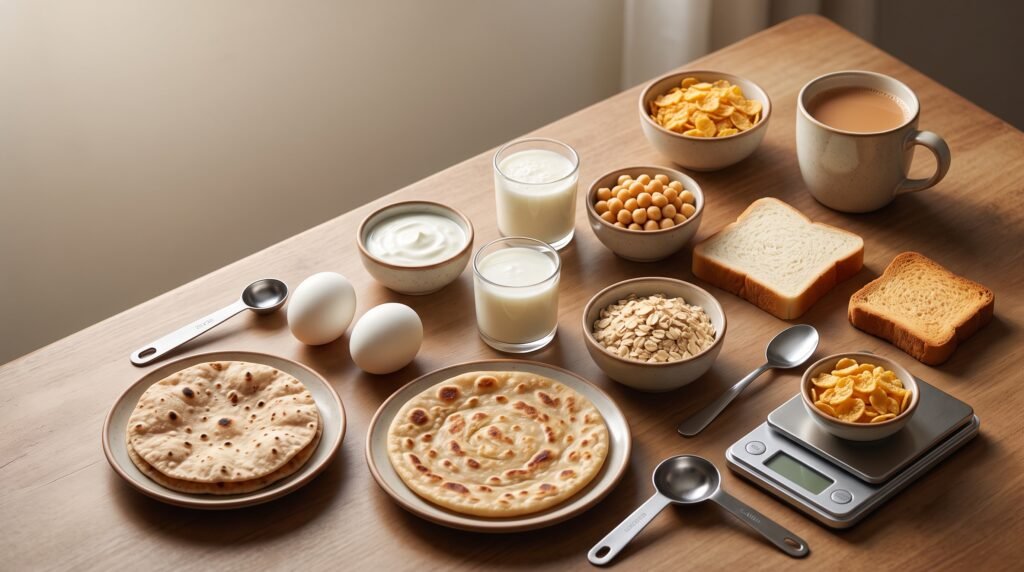
For example, a small portion of a carbohydrate-rich food may produce a much lower glycemic load than a very large portion of the same food.
This article looks at common breakfast foods—including eggs, yogurt, tea, oats, lassi, chickpeas, paratha, roti, naan, bread, rusks, halwa puri, and cornflakes—and explains how portion size can change their potential blood-sugar impact.
Important: The GI and GL figures shown here are estimates for comparison and can vary according to ingredients, preparation method, brand, recipe, cooking time, and serving size. Individual blood-glucose responses can also differ considerably.
Table of Contents
What Does Diabetes Breakfast Portion Size Mean?
Diabetes breakfast portion size simply refers to the amount of a particular food eaten at one breakfast.
This sounds straightforward, but it is easy to underestimate portions.
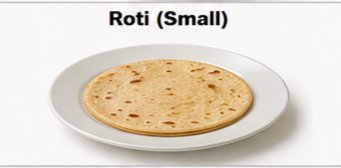
Consider a roti. One person may eat a small 30-gram roti, while another may eat a 100-gram roti. Both may describe their meal as “one roti,” but nutritionally they are very different portions.
The same thing happens with:
- Paratha
- Naan
- Bread
- Oats
- Cornflakes
- Chickpeas
- Lassi
- Rusks
Therefore, counting the number of items alone is not always enough. The weight or actual portion size can provide a much clearer picture of carbohydrate intake.
This is particularly important for people with diabetes because carbohydrate-containing foods generally have a greater immediate influence on blood glucose than foods containing very little carbohydrate.
Why Portion Size Matters in Diabetes
When you eat a carbohydrate-containing food, the amount of carbohydrate available for digestion is one factor influencing the resulting blood-glucose response.
A larger portion generally means more carbohydrate.
That does not automatically mean that every large portion will produce the same blood-glucose rise in every person. However, it explains why portion control is such an important part of diabetes meal planning.
For example, compare a small piece of roti with a very large roti.
The food is essentially the same, but the amount of carbohydrate consumed can be very different.
This is why a useful diabetes breakfast strategy is not simply:
“Is this food good or bad?”
Instead, ask:
“How much of this food am I eating?”
That small change in thinking can make portion control much easier and more realistic.
GI vs GL: What Is the Difference?
Two terms frequently appear when discussing diabetes-friendly foods: glycemic index (GI) and glycemic load (GL).
They are related, but they are not the same.
Glycemic Index
The glycemic index ranks carbohydrate-containing foods according to how quickly and how much they tend to raise blood glucose compared with a reference food.
GI does not tell you how much carbohydrate you actually ate.
For example, two foods may have a similar GI but completely different amounts of carbohydrate per serving.
Glycemic Load
Glycemic load takes both the GI and the amount of carbohydrate in a serving into account.
A commonly used calculation is:
GL = GI × available carbohydrate in the serving ÷ 100
This is one reason portion size is so important.
If you eat less of the same carbohydrate-containing food, the amount of carbohydrate in that serving falls, and therefore its calculated glycemic load generally falls as well.
A Crucial Point About Portion Size
Reducing the portion does not necessarily reduce the food’s GI.
Instead, it reduces the amount of carbohydrate consumed, which can reduce the calculated glycemic load.
This distinction is important when interpreting diabetes nutrition information.
Diabetes Breakfast Portion Size: Common Foods Compared
The following table provides a practical comparison of common breakfast foods.
The figures are intended as illustrative estimates, not individualized medical prescriptions.
| Breakfast Food | Common Serving | Approx. Carbs | Approx. GL* | More Controlled Portion | Approx. Carbs | Approx. GL* |
| Boiled eggs | 2 eggs / ~100 g | ~1 g | Very low | 2–3 eggs | ~1–2 g | Very low |
| Plain yogurt | 250 g | ~12 g | ~4 | 250 g | ~12 g | ~4 |
| Tea + sugar | 200 ml + 2 tsp sugar | ~10 g | ~7 | 200 ml + 1 tsp sugar | ~5 g | Lower |
| Cooked oats | 200 g | ~24 g | ~13 | 150 g | ~18 g | ~10 |
| Sweetened lassi | 250 ml | ~27 g | ~14 | Unsweetened lassi, 250 ml | ~15 g | Lower |
| Cooked chickpeas | 200 g | ~54 g | ~15 | 100 g | ~27 g | ~8 |
| Paratha | 100 g | ~45 g | ~27 | 35 g | ~16 g | ~10 |
| Roti | 100 g | ~50 g | ~31 | 30 g | ~15 g | ~9 |
| Bun | 100 g | ~52 g | ~37 | 25 g | ~13 g | ~9 |
| Naan | 100 g | ~55 g | ~39 | 25 g | ~14 g | ~10 |
| Rusks | 40 g / 2 pieces | ~28 g | ~20 | 1 small rusk | ~14 g | ~10 |
| White bread | 60 g / 2 slices | ~30 g | ~23 | 25 g / small slice | ~12 g | ~9 |
| Halwa puri | 2 puris + halwa | Very high | Very high | Difficult to standardize | — | — |
| Cornflakes | Large bowl | Very high | Very high | 15 g | ~13 g | ~10 |
*GL values are approximate and depend on the actual GI, carbohydrate content, recipe, and preparation. They should not be interpreted as a prediction of an individual’s blood-glucose response.
Eggs: A Breakfast Food With Very Little Carbohydrate
Eggs are an interesting example because they contain very little carbohydrate.
Two boiled eggs provide protein and fat but generally contribute very little carbohydrate. Consequently, their direct glycemic impact is minimal.
This makes eggs useful when building a breakfast around foods that provide satiety without adding a large carbohydrate load.
However, what you eat with the eggs still matters.
Two eggs with a small roti and vegetables are a very different meal from two eggs served with a large paratha, sweet tea, halwa, and several pieces of bread.
The eggs themselves may have little effect on blood glucose, but the overall meal can still contain a substantial carbohydrate load.
Plain Yogurt: Watch the Added Sugar
Plain yogurt can fit comfortably into many diabetes-friendly breakfast patterns.
Its carbohydrate content comes primarily from naturally occurring lactose, and the amount varies depending on the type and brand.
The important distinction is between plain yogurt and sweetened yogurt.
Once sugar, sweet syrups, flavored preparations, or other sweet ingredients are added, the carbohydrate content can increase.
If you enjoy yogurt at breakfast, check the nutrition information and avoid assuming that every yogurt product has the same carbohydrate content.
Tea and Sugar: A Small Change Can Add Up
For many South Asian families, breakfast is incomplete without tea.
The tea itself contributes little carbohydrate when prepared without sugar. The bigger issue is usually the amount of sugar added.
Two teaspoons of sugar contain more carbohydrate than one teaspoon.
That means reducing sugar from two teaspoons to one does not make the tea “sugar-free,” but it does reduce the amount of added sugar consumed.
This is a useful example of practical portion control.
You do not always need to make a dramatic change overnight.
Reducing sugar gradually may be easier for someone who is accustomed to very sweet tea.
And remember that if you drink several cups throughout the day, these small reductions can add up.
Oats: Healthy Does Not Mean Unlimited
Oats are often promoted as a healthy breakfast food, and they can certainly be part of a balanced eating pattern.
But one common mistake is to interpret “healthy” as “eat as much as you want.”
Oats still contain carbohydrates.
A large bowl can contain considerably more carbohydrate than a smaller serving.
Therefore, when choosing oats for breakfast, consider:
- The amount of oats used
- Whether they are cooked with milk or water
- Whether sugar or honey is added
- Whether dried fruit is included
- What other foods are eaten alongside them
A moderate portion combined with protein, such as eggs or unsweetened yogurt, may produce a more balanced meal than an oversized bowl loaded with sweet toppings.
Lassi: The Added Sugar Makes a Difference
Traditional lassi can vary enormously from one recipe to another.
Some versions are salty or plain, while others contain considerable added sugar.
This makes it difficult to judge lassi simply by its name.
A sweetened lassi can contain substantially more carbohydrate than an unsweetened version.
For someone managing diabetes, checking whether sugar has been added is therefore important.
If you enjoy lassi, an unsweetened version may be a practical way to reduce added sugar without completely eliminating a familiar food from breakfast.
Chickpeas: Nutritious but Still Portion Matters
Chickpeas are an excellent example of why “healthy” and “unlimited” are not the same thing.
They provide protein, fiber, vitamins, minerals, and carbohydrates.
Their relatively high fiber content can help make them more filling, but the carbohydrate content still contributes to the overall meal.
A 100-gram serving and a 200-gram serving are not nutritionally equivalent.
This is particularly important when chickpeas are prepared with additional ingredients such as potatoes, sauces, sugar, or substantial amounts of oil or ghee.
For breakfast, a moderate portion of chickpeas combined with vegetables and another protein source may be easier to fit into a controlled-carbohydrate meal than a very large serving.
Paratha for Diabetes: Is It About the Food or the Portion?
Paratha is one of the foods that creates the most confusion.
Many people hear that paratha is unsuitable for diabetes and conclude that it must be completely avoided.
But there is more to consider.
The size of the paratha matters.
So does the amount of oil or ghee used during preparation.
A large paratha can provide a substantial amount of carbohydrate and calories. A smaller portion provides considerably less.
Therefore, instead of asking only:
“Can a person with diabetes eat paratha?”
a more useful question is:
“What portion of paratha fits into my overall meal?”
The answer can depend on the individual’s glucose response, medication, activity level, overall diet, and health goals.
Roti Portion Size for Diabetes
Roti is a staple food in many Pakistani and South Asian households.
One of the biggest problems is that “one roti” does not have a universal size.
A small homemade roti might weigh considerably less than a large restaurant-style roti.
Consequently, counting one roti as one fixed nutritional unit can be misleading.
If you are trying to manage carbohydrate intake, weighing a few typical rotis at home can be surprisingly useful.
For example, you may discover that your usual roti is much larger than you assumed.
Reducing the size does not mean eliminating roti from the diet. It means controlling the amount of carbohydrate coming from it.
Naan and Buns: Size Makes a Big Difference
Naan can vary dramatically in size.
A small naan and a large restaurant naan should not be treated as nutritionally identical simply because both are called “one naan.”
The same applies to burger buns and other bread products.
When evaluating a bread product, consider:
Size + carbohydrate content + what you eat with it.
For example, a bun combined with a protein-rich filling and vegetables is different from a bun accompanied by fries, sugary drinks, and a sweet sauce.
The complete meal matters.
Rusks and White Bread
Rusks are another breakfast favorite, particularly with tea.
Because they are dry and relatively light, it can be surprisingly easy to eat several without realizing how much carbohydrate has been consumed.
Two rusks may look like a small amount of food, but their carbohydrate content can add up.
White bread presents a similar issue.
Two large slices may contain substantially more carbohydrate than one smaller slice.
For people who prefer bread at breakfast, checking the serving size and nutrition label can make portion control easier.
Halwa Puri: Why Portion Control Becomes Difficult
Halwa puri deserves special attention because a typical serving can combine several carbohydrate- and calorie-dense foods.
Puri is made from flour and is usually fried. Halwa contains sugar and can also contain substantial amounts of fat.
The complete meal may therefore provide a very large amount of carbohydrate and energy.
This is why simply saying “eat a smaller portion” may not always be enough to make a traditional halwa puri breakfast suitable for someone’s individual glucose targets.
If your blood sugar rises substantially after this type of meal, consider discussing the meal pattern with your healthcare professional or dietitian rather than assuming that one small adjustment will solve the problem.
For occasional consumption, the most important step may simply be recognizing that halwa puri is a high-carbohydrate, energy-dense breakfast, rather than treating it as an ordinary everyday breakfast.
Cornflakes: Don’t Judge Breakfast Foods by Their Packaging
Cornflakes are often associated with the idea of a quick and healthy breakfast.
But the serving size matters enormously.
A large bowl can contain considerably more carbohydrate than the serving listed on the package.
This is a common problem with breakfast cereals.
The manufacturer’s serving may be relatively small, while people may pour two or three times that amount into their bowl.
Milk, sugar, honey, dried fruit, and other toppings can increase the total carbohydrate content further.
If you eat cereal regularly, measure the portion at least once. It can help you understand what your usual bowl actually contains.
The Best Diabetes Breakfast Is Not Necessarily the One With the Lowest GI
It is tempting to search for one “perfect” diabetes breakfast.
In reality, breakfast quality involves more than GI.
Consider the entire meal:
- Carbohydrate quantity
- Fiber
- Protein
- Fat
- Portion size
- Added sugar
- Overall calorie intake
- Food preparation
- Individual glucose response
A food with a moderate GI can still contribute a substantial glucose load if the portion is very large.
Conversely, a food with a higher GI may sometimes be consumed in a smaller portion as part of an appropriately planned meal.
This is one reason glycemic load and portion size can be useful concepts alongside GI.
How to Build a More Diabetes-Friendly Breakfast
You do not necessarily need to completely redesign your traditional breakfast.
Instead, start with the portions.
For example, you might build a breakfast around:
Protein: eggs, plain yogurt, or another suitable protein source.
Controlled carbohydrate: a small roti, measured oats, or a smaller portion of another carbohydrate-containing food.
Vegetables: cucumber, tomato, spinach, or other non-starchy vegetables.
Drink: tea with less or no added sugar, or another unsweetened beverage.
The exact meal should be individualized, particularly for people taking insulin or medicines that can cause hypoglycemia.
A Simple Portion-Control Test
If you are unsure whether your breakfast portions are larger than necessary, try this simple experiment.
For several days, record:
- What you eat.
- The approximate weight or serving size.
- The amount of carbohydrate.
- Your blood glucose according to the monitoring schedule recommended for you.
- How you feel after the meal.
Do not change diabetes medication based on a few readings without professional guidance.
The purpose of the exercise is to identify patterns.
You may discover, for example, that your blood glucose is consistently higher after a large paratha than after a smaller one—or that sweetened tea contributes more carbohydrate than you previously realized.
Does Reducing Portion Size Lower Blood Sugar?
It can help reduce the glycemic load of a meal, particularly when the reduction involves a carbohydrate-rich food.
However, it would be incorrect to promise that cutting a portion in half will always cut a person’s blood glucose rise in half.
Blood glucose is affected by many factors, including:
- The type and amount of carbohydrate
- Fiber
- Protein and fat
- Physical activity
- Medication
- Insulin production and sensitivity
- Stress
- Sleep
- Illness
- Timing of the meal
- Individual metabolic response
Therefore, portion control is an important strategy, but it is not a guarantee of a specific blood-glucose result.
Common Mistakes People Make With Breakfast Portions
Mistake 1: Counting Items Instead of Portions
“One paratha” does not tell us how large the paratha is.
“One naan” does not tell us its weight.
“One bowl of cornflakes” is even less precise.
Mistake 2: Assuming Healthy Foods Can Be Eaten Without Limits
Oats, chickpeas, whole grains, and other nutritious foods still contain carbohydrates.
Healthy does not mean unlimited.
Mistake 3: Forgetting Drinks
People often count food but ignore beverages.
Sweet tea, sweet lassi, juices, and other sugary drinks can contribute substantial amounts of carbohydrate.
Mistake 4: Looking Only at GI
GI does not tell you how much carbohydrate is in the portion you are actually eating.
That is why GI should be interpreted alongside portion size and carbohydrate content.
Mistake 5: Making Extremely Restrictive Changes
Diabetes management should be sustainable.
A breakfast plan that eliminates every culturally familiar food may be difficult to maintain.
Practical portion control can sometimes be more realistic than complete avoidance.
Frequently Asked Questions
What is the best diabetes breakfast portion size?
There is no single portion size that is appropriate for everyone with diabetes. It depends on individual calorie and carbohydrate needs, medications, activity level, and glucose targets. However, controlling portions of carbohydrate-rich foods is an important general strategy.
Can people with diabetes eat paratha for breakfast?
Some people with diabetes may be able to include paratha in a controlled portion. The size of the paratha, amount of oil or ghee, accompanying foods, and individual blood-glucose response all matter.
How much roti should a person with diabetes eat at breakfast?
There is no universal number of rotis suitable for every person. A small roti contains considerably less carbohydrate than a large roti, so portion size and total carbohydrate are more useful measures than simply counting rotis.
Is oatmeal good for people with diabetes?
Oats can be included in a diabetes-friendly diet, but portion size matters. Choose a reasonable serving and be careful with added sugar, honey, sweetened milk, dried fruit, and other carbohydrate-rich toppings.
Is lassi suitable for diabetes?
Unsweetened lassi may be easier to incorporate into a diabetes-friendly breakfast than sugar-sweetened lassi. Always consider the carbohydrate content of the actual recipe and serving size.
Can diabetics eat chickpeas for breakfast?
Chickpeas can be a nutritious breakfast option because they provide protein and fiber along with carbohydrate. However, large servings can contribute a significant amount of carbohydrate, so portion control remains important.
Is cornflakes good for diabetes?
Cornflakes can contain a substantial amount of carbohydrate and may have a relatively high GI. The portion size and what you add to the cereal also matter. Measuring the serving rather than filling the bowl without measuring can help control carbohydrate intake.
Is halwa puri suitable for people with diabetes?
Halwa puri is a carbohydrate- and calorie-dense meal, and a typical serving can produce a substantial glycemic load. People whose glucose is difficult to control should be particularly cautious with this type of breakfast and discuss individualized choices with their healthcare professional.
Does a smaller portion always mean lower blood sugar?
Not necessarily. A smaller carbohydrate portion generally reduces the amount of carbohydrate consumed and therefore can reduce calculated glycemic load, but individual blood-glucose responses vary. Portion reduction should not be interpreted as a guarantee of a specific glucose reading.
What is more important: GI or portion size?
Both can matter. GI describes the relative blood-glucose response to a carbohydrate-containing food, while glycemic load incorporates both GI and the amount of carbohydrate consumed. Therefore, portion size is an important part of understanding the actual carbohydrate impact of a meal.
Final Thoughts: Portion Size Can Change the Whole Breakfast
Managing diabetes does not always mean completely abandoning the foods you enjoy.
Sometimes the more practical starting point is to look carefully at how much is on the plate.
A large paratha and a small paratha are not the same from a carbohydrate perspective. Two large slices of bread are different from one small slice. A large bowl of cornflakes is very different from a measured serving. Two teaspoons of sugar provide more carbohydrate than one.
The key message is simple:
Diabetes breakfast portion size matters.
Instead of asking only whether a particular food is “good” or “bad” for diabetes, look at the portion, carbohydrate content, glycemic load, preparation method, and the rest of the meal.
Eggs and plain yogurt can provide lower-carbohydrate options, while foods such as oats, chickpeas, roti, paratha, naan, bread, and cereal can still potentially be included when portions are appropriate for the individual.
And for foods such as halwa puri or heavily sweetened breakfast items, portion control may be more challenging because the total carbohydrate and calorie content can become very high very quickly.
Ultimately, there is no single breakfast that works for every person with diabetes.
The goal is to build a breakfast that is nutritious, portion-controlled, realistic, culturally familiar, and compatible with your individual diabetes management plan.
Because sometimes the most important change is not removing a food from your plate—it is simply putting less of it on the plate.