
Dates are naturally sweet, nutritious fruits that are widely enjoyed across South Asia, the Middle East, and many other parts of the world. They are especially popular during Ramadan, at breakfast, as a snack, and as a natural alternative to refined sweets.
But if you have diabetes, you may have an important question: Are fresh dates better than dried dates for blood sugar?
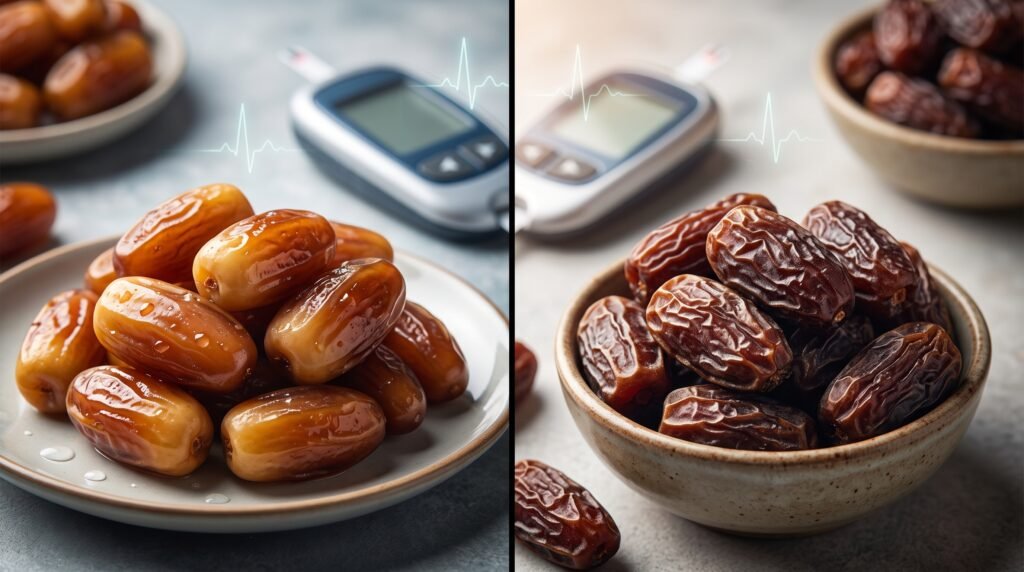
The answer is not simply about whether a date is fresh or dried. The amount you eat matters enormously. Drying removes much of the water from dates, making the remaining carbohydrates, sugars, and calories more concentrated by weight. This means that 20 grams of dried dates can provide considerably more carbohydrate than the same weight of a water-rich fresh date.
At the same time, dates are not automatically a food that people with diabetes must completely avoid. Research has found that several date varieties have relatively low to moderate glycemic indices, although values vary considerably between varieties and preparation stages. Studies in people with and without type 2 diabetes have reported date GI values generally in the low-to-moderate range.
So, when comparing fresh dates vs dried dates for diabetes, it is useful to look beyond sweetness and consider carbohydrates, calories, portion size, glycemic index, and especially glycemic load.
Table of Contents
What Is the Difference Between Fresh and Dried Dates?
Fresh and dried dates come from the same fruit, but their water content can be very different.
Fresh dates, particularly softer fresh or semi-ripe forms such as rutab, contain substantially more water. As dates mature and dry, water is lost and the sugars and other nutrients become more concentrated.
This is why a dried date can taste much sweeter than a fresh date even though both come from the same fruit.
The difference becomes particularly important when comparing the foods by weight.
For example, USDA-derived nutrition data for Medjool dates list about 277 calories and 75 grams of carbohydrate per 100 grams, with around 21 grams of water.
Fresh-date nutrition varies substantially according to variety and stage of ripeness. One current nutrition reference reports approximately 142 calories and 36 grams of carbohydrate per 100 grams for fresh dates, while other fresh-date datasets report lower values. This variation is one reason it is better to treat fresh-date nutrition figures as approximate rather than universal.
In simple terms:
Fresh dates contain more water, while dried dates contain more nutrients and carbohydrates per gram.
Fresh Dates vs Dried Dates: Nutrition Comparison
The exact nutritional composition of dates depends on variety, ripeness, moisture content, and whether the fruit is classified as fresh, semi-ripe, or dried.
The following table provides a practical comparison using representative values rather than suggesting that every date variety will have exactly the same composition.
| Nutrient | Fresh Dates* | Dried Dates** |
|---|---|---|
| Calories per 100 g | ~125–145 kcal | ~277–282 kcal |
| Carbohydrates | ~31–36 g | ~75 g |
| Natural sugars | ~30–32 g | ~63–66 g |
| Fiber | ~3–4 g | ~6.7–8 g |
| Protein | ~1–1.5 g | ~1.8–2.5 g |
| Fat | Very low | Very low |
| Water | Much higher | ~20–21 g |
| Overall carbohydrate concentration | Lower | Higher |
*Fresh-date values vary substantially by variety and ripening stage.
**Dried-date values are representative of common dried varieties such as Medjool and Deglet Noor.
The most important point for someone with diabetes is not necessarily the calorie difference. It is the carbohydrate concentration.
When water is removed, you can eat several dried dates without realizing how much carbohydrate you have consumed.
Why Do Dried Dates Have More Carbohydrates Per 100 Grams?
The answer is mainly water.
Imagine putting fresh fruit in the sun and allowing some of its water to evaporate. The carbohydrate doesn’t disappear with the water. Instead, the remaining food becomes more concentrated.
That is essentially what happens when dates move toward the dried or tamr stage.
Research examining date composition has shown that moisture content changes considerably during the different stages of date development. A review comparing fresh rutab and dried tamr dates also demonstrated substantial differences in moisture, carbohydrate concentration, and energy content.
This explains an important concept:
Dried dates do not necessarily contain a different type of carbohydrate simply because they are dried. They are generally more concentrated because much of their water has been removed.
For diabetes management, that concentration can make portion control more important.
Are Dates High in Sugar?
Yes, dates are naturally rich in sugars.
However, the word “sugar” should not be interpreted in exactly the same way as “added sugar.”
Dates contain naturally occurring sugars along with fiber and other nutrients. They are also a whole fruit rather than a beverage or a spoonful of refined sugar.
A 100-gram serving of Medjool dates contains approximately 75 grams of carbohydrate and around 66 grams of naturally occurring sugars according to USDA-derived data.
Dried dates listed by the Glycemic Index Research Service contain about 19.2 grams of carbohydrate in a 25-gram serving, including approximately 16.5 grams of natural sugars and 2.4 grams of dietary fiber.
That is why eating ten dried dates can be very different from eating one or two.
The key question for someone with diabetes is therefore not simply:
“Do dates contain sugar?”
They clearly do.
The more useful question is:
“How much carbohydrate am I eating in the portion I choose?”
What Is the Glycemic Index of Dates?
The glycemic index, or GI, describes how quickly a carbohydrate-containing food raises blood glucose compared with a reference food.
Dates can have a relatively low-to-moderate GI, but there is no single GI value that applies to every date.
In one clinical study, five varieties of dates had GI values ranging from approximately 46 to 55 in healthy participants. The corresponding values in people with type 2 diabetes were approximately 44 to 53.
Another study examining 17 varieties of Saudi Arabian dates found GI values ranging from 42.8 to 74.6, showing how much the result can vary between varieties.
This is an important reason not to say that “all dates have a GI of 54.”
A commonly cited average for dates is around 54, but individual varieties can be substantially different.
Glycemic Index vs Glycemic Load: Why Does It Matter?
This distinction is particularly important for the fresh dates vs dried dates for diabetes comparison.
GI tells us about the relative blood glucose response to a carbohydrate-containing food.
Glycemic load, or GL, goes one step further by considering the amount of available carbohydrate in the portion eaten.
A commonly used calculation is:
GL = GI × available carbohydrate in the serving ÷ 100
This means that even a food with a relatively low or moderate GI can produce a meaningful glycemic load if a large amount is eaten.
This is exactly why portion size matters with dates.
A small portion of dates can have a relatively modest glycemic load, while a large portion can provide much more carbohydrate.
Fresh Dates vs Dried Dates: Glycemic Load Comparison
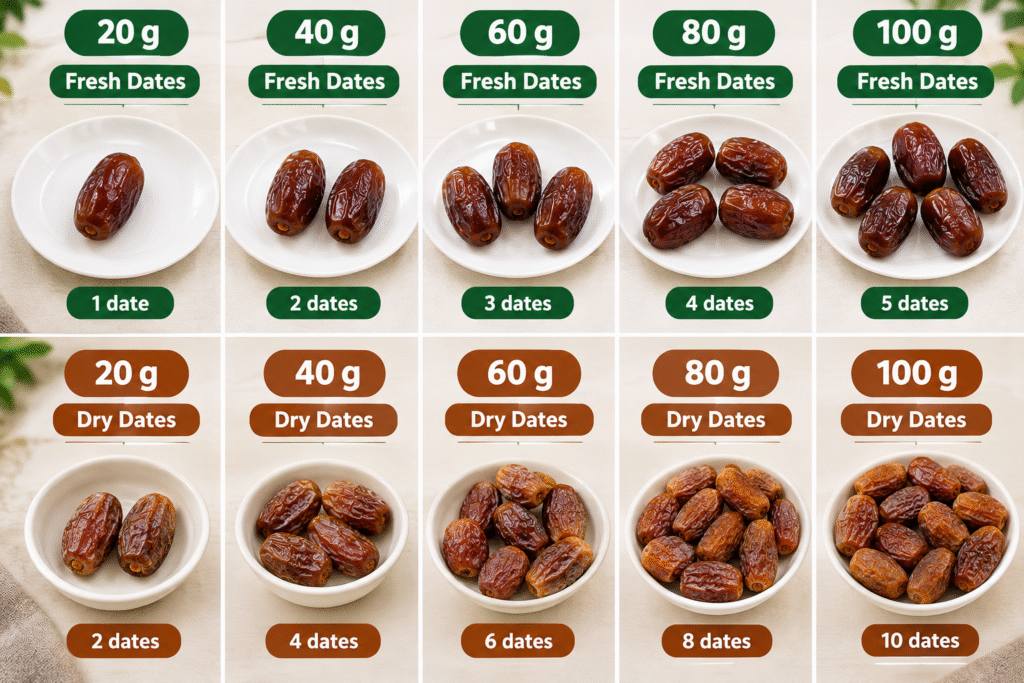
Because glycemic load depends on both GI and carbohydrate content, we need to be careful when comparing fresh and dried dates.
The following table is best understood as an illustrative calculation, not a universal laboratory measurement for every fresh or dried date variety.
Using a GI around 54 as an example, the estimated GL changes as the available carbohydrate in the portion changes.
| Portion | Approx. Fresh-Date Carbohydrate* | Illustrative GL at GI 54 | Dried-Date Carbohydrate** | Illustrative GL at GI 54 |
|---|---|---|---|---|
| 20 g | ~6.3–7.2 g | ~3.4–3.9 | ~15 g | ~8.1 |
| 40 g | ~12.5–14.4 g | ~6.8–7.8 | ~30 g | ~16.2 |
| 60 g | ~18.8–21.6 g | ~10.1–11.7 | ~45 g | ~24.3 |
| 80 g | ~25–28.8 g | ~13.5–15.6 | ~60 g | ~32.4 |
| 100 g | ~31–36 g | ~16.7–19.4 | ~75 g | ~40.5 |
*Fresh-date carbohydrate varies significantly by variety and maturity.
**Dried-date values use approximately 75 g carbohydrate per 100 g, consistent with USDA-derived data for common dried dates.
These are calculated estimates, not direct clinical GL measurements for each portion.
The important message is the trend: when the same weight contains substantially more available carbohydrate, its potential glycemic load will also be higher if the GI is similar.
Clinical studies have demonstrated that date glycemic load can vary considerably between varieties. In a study of 17 Saudi Arabian date varieties, measured GL values ranged from about 8.5 to 24 for the tested portions.
Why Portion Size Matters More Than Counting Dates
This is where many people make a mistake.
Someone may say:
“I only ate four dates.”
But four dates can mean very different amounts depending on their size, variety, moisture level, and whether they are fresh or dried.
For example, a large Medjool date can weigh considerably more than a small date variety.
Therefore, counting dates alone is not always a reliable way to estimate carbohydrate intake.
Weight or a consistent portion is more useful.
A person who eats two large dried dates may consume a very different amount of carbohydrate from someone who eats two small fresh dates.
This is one reason portion control should be part of any discussion about fresh dates vs dried dates for diabetes.
Are Fresh Dates Better Than Dried Dates for Diabetes?
If we compare the same weight, fresh dates generally contain less carbohydrate and fewer calories than dried dates because they contain more water.
That can make fresh dates easier to fit into a carbohydrate-controlled diet.
But this does not mean that dried dates are automatically unhealthy or forbidden for people with diabetes.
A small portion of dried dates may contain less carbohydrate than a large bowl of fresh dates.
For example, comparing 20 grams of each is much more meaningful than simply saying “fresh is good and dried is bad.”
The total amount eaten still matters.
Can People With Diabetes Eat Dried Dates?
For many people with diabetes, dates can potentially be included as part of an overall balanced eating pattern.
Clinical research does not support the idea that people with diabetes universally need to eliminate dates. A study involving people with type 2 diabetes found that several tested date varieties had relatively low GI values, and the researchers did not observe significant post-meal glucose excursions from the tested portions.
A later review of the research similarly reported that date GI values vary considerably and found that available studies generally did not demonstrate worsening of glycemic control simply from including dates in the diet.
However, this should not be interpreted as meaning that unlimited dates are appropriate.
A low or moderate GI does not make a high-carbohydrate portion carbohydrate-free.
Portion size still matters.
How Many Dates Can a Person With Diabetes Eat?
There is no single number that is appropriate for everyone with diabetes.
The suitable amount depends on factors such as:
- Total carbohydrate needs
- Current blood glucose levels
- Medications or insulin
- Physical activity
- Other foods eaten with the dates
- Individual response to carbohydrates
- Overall calorie requirements
For practical purposes, a person may find it easier to start with a small portion, rather than eating a large handful of dates.
For example, one or two dates may be easier to incorporate into a meal plan than five, six, or ten dates.
The important thing is to count their carbohydrates as part of the overall meal.
If you monitor blood glucose, your own response can also provide useful information. A healthcare professional or registered dietitian can help determine how dates fit into an individual’s carbohydrate plan.
Does Eating Dates With Other Foods Matter?
Yes.
Dates are often eaten alone, but they can also be combined with foods containing protein, fat, or fiber.
For example, someone might eat a small amount of dates with nuts or include dates as part of a balanced meal.
However, combining dates with another food does not erase the carbohydrate in the dates.
It is better to think of the entire meal rather than looking at one ingredient in isolation.
If a meal already contains rice, roti, bread, potatoes, or another substantial carbohydrate source, adding several dates may significantly increase the total carbohydrate load.
This is another reason the overall meal matters.
Fresh Dates vs Dried Dates: Which Has More Calories?
Dried dates generally have considerably more calories per 100 grams because they contain much less water.
For example, USDA-derived data list approximately 277 calories per 100 grams for Medjool dates, while some fresh-date references report roughly 124–145 calories per 100 grams, depending on the variety and stage of ripeness.
This does not mean that every serving of dried dates will contain more calories than every serving of fresh dates.
Again, portion size changes the comparison.
A 20-gram serving of dried dates may contain fewer total calories than a 100-gram serving of fresh dates.
So when comparing calories, always ask:
“How much am I actually eating?”
What About Fiber in Dates?
Dates contain dietary fiber, which is one reason they are nutritionally different from refined sugar.
Dried dates generally have more fiber per 100 grams than fresh dates because the nutrients become concentrated as water is removed.
USDA-derived data list approximately 6.7 grams of fiber per 100 grams of Medjool dates, while Deglet Noor dates contain around 8 grams per 100 grams.
Fiber is beneficial as part of an overall healthy diet, but it does not mean that the carbohydrate in dates should be ignored.
A useful approach is to appreciate both sides:
Dates provide fiber and nutrients, but they also provide a substantial amount of carbohydrate.
Are Dates Better Than Refined Sweets?
This question requires some nuance.
Dates are a whole fruit and provide fiber, minerals, and other plant compounds in addition to naturally occurring sugars.
Dried dates also contain minerals such as potassium, magnesium, copper, and manganese.
That makes dates nutritionally different from foods that primarily provide added sugar with little nutritional value.
But “more nutritious” does not mean “carbohydrate-free.”
If someone replaces a sugary dessert with a small portion of dates, that may be a sensible dietary choice. But eating a large quantity of dates because they are “natural” can still provide a substantial carbohydrate and calorie load.
Natural sugar is still carbohydrate. Portion size still matters.
Practical Tips for Eating Dates With Diabetes
If you enjoy dates and want to include them in your diet, a few simple strategies can help.
1. Keep the portion modest
Instead of eating a large handful, start with a smaller portion and account for the carbohydrate.
2. Consider the type of date
Large dried dates can contain considerably more carbohydrate per piece than small dates.
3. Look at total carbohydrates
Don’t judge a food only by how sweet it tastes. Check the carbohydrate content of the amount you actually eat.
4. Avoid stacking carbohydrates
If your meal already contains a large serving of rice, naan, roti, bread, or potatoes, adding several dates may substantially increase the meal’s carbohydrate load.
5. Consider your individual glucose response
People respond differently to carbohydrate-containing foods. If you use a glucose meter or continuous glucose monitor, your readings can help you understand your own response.
6. Don’t assume dried fruit is automatically healthier
Drying can make fruit convenient and shelf-stable, but it also concentrates carbohydrates and calories.
Fresh Dates vs Dried Dates: Which Should You Choose?
There is no need to turn this into an “all or nothing” decision.
If your main concern is reducing carbohydrate and calorie concentration per 100 grams, fresh dates generally have an advantage because of their higher water content.
If you prefer dried dates, you can still potentially include them by keeping the portion controlled.
For someone with diabetes, the better question is not:
“Are fresh dates healthy and dried dates unhealthy?”
A more useful question is:
“Which portion fits my carbohydrate needs and overall meal?”
That approach is much more practical.
Frequently Asked Questions
Are fresh dates better than dried dates for diabetes?
Fresh dates generally contain more water and fewer carbohydrates and calories per 100 grams than many dried dates. However, the appropriate choice depends on the portion eaten and the individual’s overall dietary needs.
Can diabetics eat dried dates?
People with diabetes may be able to include dried dates in a balanced diet. Research has found relatively low-to-moderate GI values for several date varieties, but portion size remains important because dried dates are carbohydrate-dense.
Do dried dates raise blood sugar?
Dried dates contain a substantial amount of carbohydrate, so they can contribute to a rise in blood glucose. The size of the rise depends on the portion, the date variety, the meal, and the individual’s glucose response.
What is the glycemic index of dates?
The GI of dates varies by variety and ripening stage. Research has reported values ranging from approximately 42.8 to 74.6 across different date varieties.
What is the glycemic load of dates?
There is no single GL for all dates. It depends on the variety, carbohydrate content, and portion size. In one study of 17 Saudi date varieties, measured GL values ranged from 8.5 to 24 for the portions tested.
Are dates high in natural sugar?
Yes. Dates contain a high proportion of naturally occurring sugars. Dried dates are particularly concentrated because much of their water has been removed.
How many dates can a diabetic eat?
There is no universal number suitable for everyone. A smaller portion, such as one or two dates depending on size and variety, may be easier to incorporate into a carbohydrate-controlled meal than a large serving. Individual carbohydrate requirements and glucose responses should be considered.
Are dried dates more caloric than fresh dates?
Generally, yes when comparing the same weight. Dried dates contain much less water, so their calories and carbohydrates are more concentrated.
Should people with diabetes completely avoid dates?
Not necessarily. Current evidence does not support a blanket rule that everyone with diabetes must eliminate dates. However, dates should still be counted as a carbohydrate-containing food, and portion control is important.
Is a low glycemic index enough to make dates safe for diabetes?
No. GI is only one part of the picture. Glycemic load and portion size also matter. A food with a relatively low GI can still provide a substantial carbohydrate load when eaten in a large quantity.
Conclusion
The comparison between fresh dates vs dried dates for diabetes becomes much clearer when we look beyond sweetness.
Fresh dates contain more water, while dried dates are more concentrated. As a result, dried dates generally provide more carbohydrates and calories per 100 grams. Their glycemic load can therefore become substantially higher when the same weight is compared, particularly when a relatively similar GI is assumed.
At the same time, dates are not simply a “forbidden food” for people with diabetes. Research has found that the glycemic index of dates varies by variety, and several varieties have demonstrated low-to-moderate GI values in clinical studies.
The most useful lesson is portion control.
Whether you choose fresh dates or dried dates, pay attention to the amount you eat, the carbohydrates in that portion, and the other foods in the same meal. A small portion can be very different from a large serving.
So, rather than asking only, “Fresh or dried—which is better?”, ask the more useful question:
“How much carbohydrate am I getting from the portion I am actually eating?”
For people managing diabetes, that simple change in thinking can make the difference between treating dates as an occasional, measured part of the diet and unintentionally turning a small fruit serving into a large carbohydrate load.