
Are chickpeas for diabetes a good choice, or can they raise blood sugar too much? If you have diabetes, you may have asked yourself this question while deciding what to eat for lunch, dinner, or a healthy snack. Chickpeas, also known as garbanzo beans or chana, are a familiar food in Pakistani, Indian, and Middle Eastern cuisines. They are used in boiled chickpea salads, chana chaat, chana masala, chickpea curry, hummus, cutlets, and countless other dishes.
Chickpeas are rich in fiber, contain plant-based protein, and provide several essential nutrients. They also tend to have a relatively low glycemic index when cooked and eaten on their own. However, the effect of chickpeas on blood sugar depends on portion size, preparation method, added ingredients, and the other foods eaten with them.
For example, a serving of plain boiled chickpeas is nutritionally different from a plate of chickpeas served with white rice. Similarly, hummus may contain relatively few carbohydrates per spoonful but more calories because of tahini and oil. Deep-fried chickpea cutlets may contain additional starch and fat.
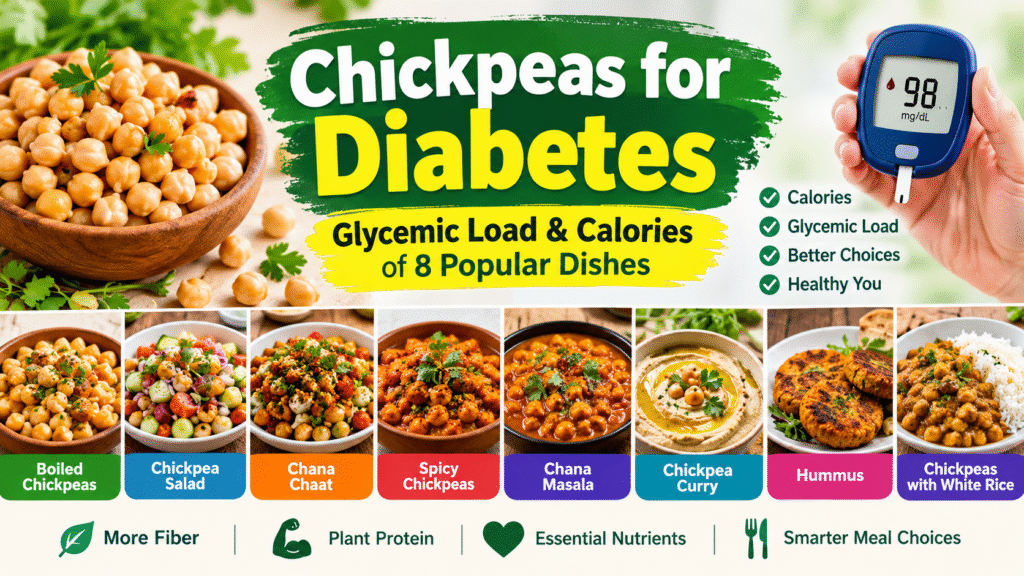
In this guide, we will explore chickpeas for diabetes in practical terms, including their nutritional benefits, glycemic index, estimated glycemic load, calories, and the differences between eight popular chickpea dishes. You will also learn how to enjoy chickpeas while managing carbohydrate intake and monitoring your blood glucose response.
Table of Contents
1. Are Chickpeas Good for Diabetes?
Yes, chickpeas can be a nutritious food choice for many people with diabetes when eaten in appropriate portions. They provide a combination of fiber, protein, complex carbohydrates, and minerals that can help make meals more satisfying.
Unlike foods made primarily from refined starch or added sugar, chickpeas contain substantial amounts of fiber and protein. Their carbohydrate structure and intact food matrix can also contribute to a relatively gradual rise in blood glucose compared with some refined carbohydrate foods.
However, chickpeas are not carbohydrate-free. Eating a very large portion can still contribute a substantial amount of carbohydrate to a meal and increase blood glucose.
Here are some reasons why chickpeas can fit into a diabetes-friendly eating pattern:
- Fiber: Chickpeas contain soluble and insoluble fiber, which supports digestive health and can help moderate the rate at which carbohydrates are digested.
- Plant-based protein: Protein helps make meals more satisfying and supports normal body functions.
- Complex carbohydrates: Chickpeas provide carbohydrate alongside fiber and other nutrients.
- Minerals: They supply nutrients such as folate, iron, magnesium, and potassium.
- Food versatility: They can replace some refined starches or be combined with vegetables and other nutritious foods.
The key is not to treat chickpeas as a food that can be eaten without limits. Instead, consider the amount you eat, the recipe, and your overall meal.
2. Understanding the Glycemic Index and Glycemic Load of Chickpeas
Before comparing different chickpea dishes, it helps to understand two important nutritional terms: glycemic index (GI) and glycemic load (GL).
What Is the Glycemic Index?
The glycemic index measures how quickly a carbohydrate-containing food raises blood glucose compared with a reference food, usually glucose or white bread, depending on the testing method.
GI values are commonly classified as follows:
| Glycemic index category | GI value |
| Low GI | 55 or less |
| Medium GI | 56–69 |
| High GI | 70 or more |
Cooked chickpeas generally have a low GI, although the exact value varies according to the variety, cooking method, and study conditions.
A low GI does not mean a food contains no carbohydrates or cannot increase blood glucose. It means that the carbohydrate in the tested food produces a relatively lower or slower glucose response under the study conditions.
What Is the Glycemic Load?
The glycemic load considers both the GI of a food and the amount of available carbohydrate in a particular serving.
The formula is:
Glycemic load = GI × available carbohydrates per serving (g) ÷ 100
For example, suppose a hypothetical serving contains 20 grams of available carbohydrate and has a GI of 30.
Its estimated GL would be:
30 × 20 ÷ 100 = 6.
This example illustrates the calculation rather than establishing a universal GL for chickpeas.
Glycemic load is often classified using the following approximate ranges:
| Glycemic load category | GL per serving |
| Low | 10 or less |
| Medium | 11–19 |
| High | 20 or more |
These categories are useful for comparing portions, but they should not be interpreted as direct predictions of an individual’s blood glucose reading.
Why does this matter for chickpeas for diabetes? A modest serving of chickpeas may have a relatively low GL, while a much larger portion—or a meal combining chickpeas with a substantial amount of rice—can have a considerably higher GL.
3. Nutritional Value of Boiled Chickpeas
Plain boiled chickpeas are a useful starting point because they provide a relatively simple way to estimate the nutrients in a serving before adding oil, sauces, potatoes, or other ingredients.
According to standard food-composition data, 100 grams of cooked chickpeas provides approximately the following nutrients. Actual values vary with the variety, cooking method, and water absorbed during cooking.
| Nutrient | Approximate amount per 100 g cooked chickpeas |
| Calories | 164 kcal |
| Total carbohydrates | 27.4 g |
| Dietary fiber | 7.6 g |
| Protein | 8.9 g |
| Total fat | 2.6 g |
| Natural sugars | 4.8 g |
| Folate | 172 µg |
| Iron | 2.9 mg |
| Potassium | 291 mg |
Values are approximate reference figures for cooked chickpeas without added salt or oil.
Notice that chickpeas contain both carbohydrates and fiber. This combination is one reason they can be a useful alternative to some refined carbohydrate foods.
However, the carbohydrate content still matters. A 150-gram serving contains considerably more carbohydrate than a 50-gram serving, even though both portions have a similar nutritional composition per gram.
4. Glycemic Load and Calories of 8 Popular Chickpea Dishes
Chickpeas are prepared in many different ways across Pakistan, India, and other countries. The same basic ingredient can produce very different meals depending on what is added.
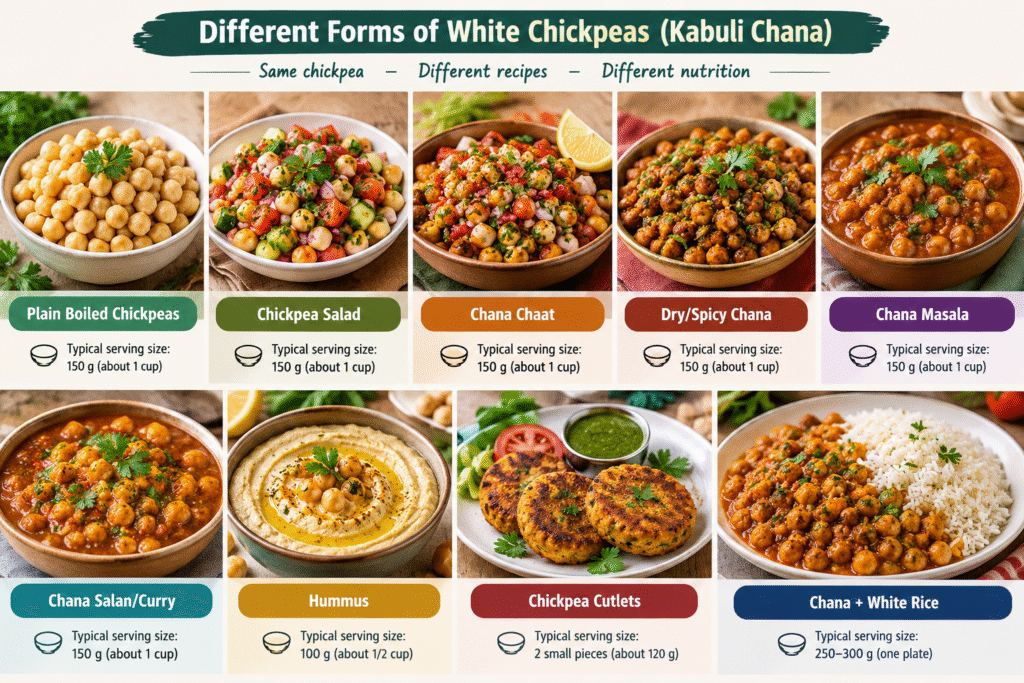
The following table provides approximate estimates for eight popular preparations. These figures are illustrative estimates, not laboratory-tested values for standardized recipes.
| Chickpea dish | Approximate serving | Estimated calories | Estimated glycemic load |
| Plain boiled chickpeas | 150 g | 240–250 kcal | Around 9 |
| Chickpea salad | 150 g | 190–220 kcal | 6–8 |
| Chana chaat | 150 g | 200–250 kcal | 7–10 |
| Spicy chickpeas with a little oil | 150 g | 230–280 kcal | 6–9 |
| Chana masala | 150 g | 220–280 kcal | 6–10 |
| Chickpea curry | 150 g | 230–320 kcal | 7–12 |
| Hummus | 100 g | 160–220 kcal | Around 1–2 |
| Chickpea cutlets | 120 g, two small pieces | 250–350 kcal | 9–16 |
Important: The estimates above are recipe-dependent and should not be treated as precise nutritional measurements. They may not be directly comparable because serving sizes and ingredient proportions differ. For example, a salad containing less chickpea and more cucumber may have fewer calories and carbohydrates than one containing mostly chickpeas. A cutlet made with potatoes, flour, and deep-frying oil can differ substantially from one made with chickpeas and vegetables and cooked with minimal oil.
The most reliable way to calculate a dish’s nutritional value is to determine the ingredients, weigh them, calculate the total nutrients in the recipe, and divide those totals by the number of servings.
1. Plain Boiled Chickpeas
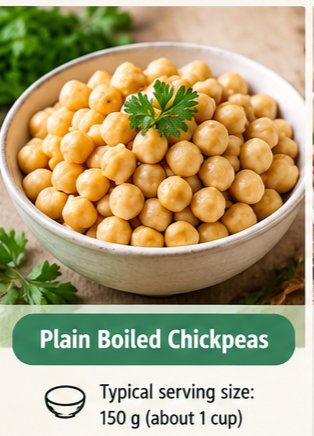
Plain boiled chickpeas are one of the simplest ways to include chickpeas in a diabetes-friendly eating pattern.
A serving of approximately 150 grams provides about 246 calories, 41 grams of total carbohydrates, 11 grams of fiber, and 13 grams of protein. These are approximate values based on standard cooked-chickpea composition data.
The fiber and protein contribute to satiety, while the carbohydrate content means that portion size remains important.
Practical tip: Measure your serving instead of filling a large bowl without considering its weight. You can combine boiled chickpeas with cucumber, tomatoes, lemon juice, and fresh herbs for additional variety.
2. Chickpea Salad
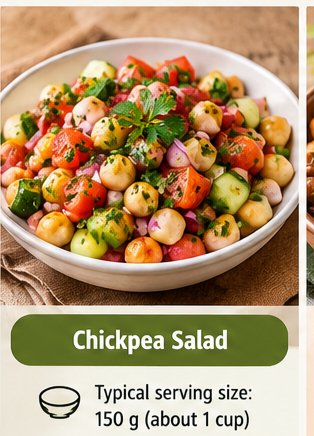
Chickpea salad is a convenient option for people who want to combine legumes with vegetables.
A typical salad may contain:
- Boiled chickpeas
- Cucumber
- Tomatoes
- Onion
- Lemon juice
- Fresh coriander or mint
- Black pepper and other spices
Cucumber and tomatoes add volume and variety without contributing as many calories as oil-rich sauces or fried ingredients.
However, the nutritional value depends on the proportion of chickpeas to vegetables. A salad made primarily from chickpeas will contain more carbohydrate than one made with a smaller amount of chickpeas and a larger quantity of non-starchy vegetables.
A simple approach: Start with a measured serving of chickpeas and add plenty of vegetables. Use lemon juice and spices for flavor, and measure any oil you add.
3. Chana Chaat
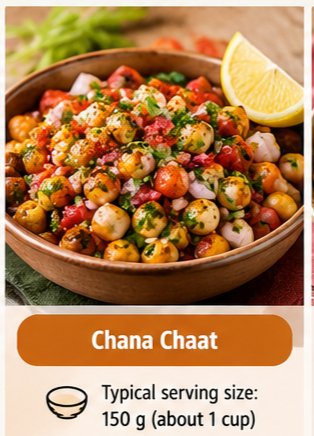
Chana chaat is popular throughout Pakistan and India. It is often prepared with boiled chickpeas, tomatoes, onions, coriander, lemon juice, and spices.
The dish can be a nutritious choice, but its nutritional profile changes when additional ingredients are included.
For example, potatoes contribute additional carbohydrates. Sweet chutneys may add sugar, while fried toppings can increase the calorie content.
This does not mean that people with diabetes must avoid chana chaat. Instead, the ingredients and portion size should be considered.
How to make chana chaat more suitable for diabetes:
- Use a measured quantity of boiled chickpeas.
- Add cucumber, tomatoes, onions, and other non-starchy vegetables.
- Flavor the dish with lemon juice, coriander, mint, and spices.
- Limit sweet chutney and consider reducing the amount of potato.
- Avoid routinely adding fried toppings.
Remember that even a nutritious dish can contribute a substantial amount of carbohydrate if the serving is too large.
4. Spicy Chickpeas
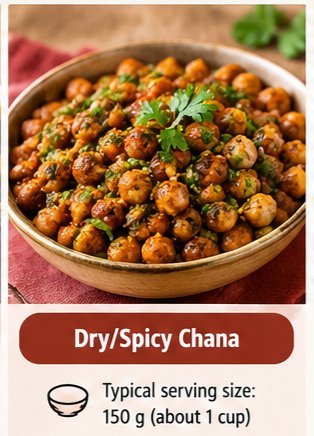
Spicy chickpeas can be prepared by seasoning boiled chickpeas with spices and a small amount of oil.
Common seasonings include cumin, coriander, chili powder, black pepper, turmeric, and lemon juice. These ingredients can add flavor without requiring large amounts of oil or sugar.
The main nutritional consideration is how the chickpeas are cooked.
If the recipe uses a modest amount of oil, the calorie content may remain relatively manageable. If the chickpeas are fried or coated in substantial amounts of oil, the calories can rise significantly.
Also, dry or roasted chickpeas are not nutritionally identical to boiled chickpeas. Removing moisture concentrates their nutrients per 100 grams, so a 100-gram serving of dry chickpeas should not be compared directly with 100 grams of boiled chickpeas.
Practical tip: Pay attention to whether your portion is weighed before or after cooking. This distinction makes a difference when estimating calories and carbohydrates.
5. Chana Masala
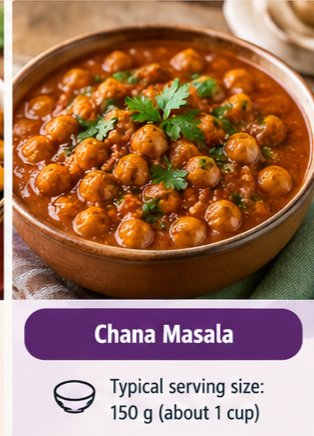
Chana masala is a familiar dish made with chickpeas, tomatoes, onions, and spices. It can fit into a balanced diet for people with diabetes.
However, recipes vary considerably between households and restaurants.
Some versions use a tomato-based gravy with a modest amount of oil. Others contain more oil, thicker gravy, or additional ingredients that change the nutritional profile.
A restaurant serving may also be much larger than the portion you would prepare at home.
When estimating the glycemic load of chana masala, remember that the amount of chickpeas is particularly important because it determines much of the available carbohydrate in the dish. Added ingredients can change the overall calculation.
For a more balanced meal, consider serving a moderate portion of chana masala with non-starchy vegetables and an appropriate portion of whole-grain roti or another carbohydrate source.
If you eat roti with the dish, remember that the roti contributes additional carbohydrates. The effect on blood glucose depends on the entire meal, not just the chickpeas.
6. Chickpea Curry
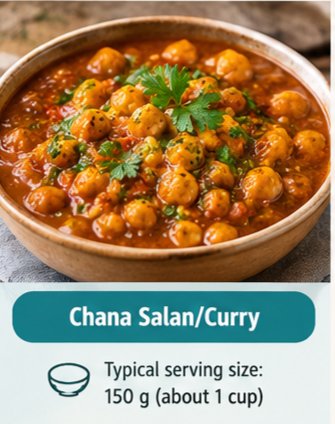
Chickpea curry can be nutritious, but its calories and carbohydrate content depend on the recipe.
A curry prepared with chickpeas, tomatoes, onions, spices, and a modest amount of oil will differ from a richer version containing substantial oil or other ingredients.
The amount of gravy included in a 150-gram serving also matters. A serving containing mostly chickpeas is different from one containing mostly gravy.
When comparing chickpea curries, ask three questions:
- How much of the serving consists of chickpeas?
- How much oil is used in the recipe?
- Is the curry served with rice, roti, naan, or another carbohydrate source?
The third question is especially important. Even when the curry itself has a relatively modest glycemic load, the total meal may contain considerably more carbohydrate if it is accompanied by large portions of rice or bread.
7. Hummus
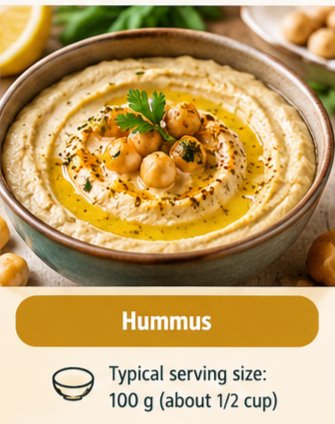
Hummus is a dip traditionally prepared with chickpeas, tahini, lemon juice, garlic, and other ingredients. Some recipes also include additional olive oil.
Chickpeas provide fiber and protein, while tahini contributes fat and additional calories. As a result, hummus can be relatively low in glycemic load per serving while still being calorie-dense.
A small serving used as a dip with cucumber, carrots, or other vegetables can be a practical choice.
However, hummus is often eaten with pita bread, crackers, or other carbohydrate-containing foods. These accompaniments must be considered when estimating the overall meal’s carbohydrate content and glycemic load.
It is also worth distinguishing between the glycemic load of hummus itself and that of a complete meal containing hummus and bread. They are not interchangeable measurements.
Practical tip: Measure hummus with a spoon rather than assuming that a large bowl contains a small serving. Choose vegetable accompaniments more often when they suit your meal plan.
8. Chickpea Cutlets
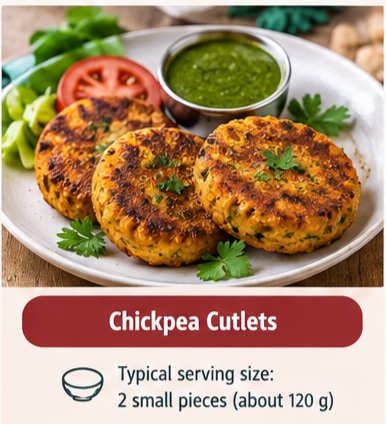
Chickpea cutlets are another popular preparation. Depending on the recipe, they may contain mashed chickpeas, potatoes, flour, breadcrumbs, onions, herbs, and spices.
The nutritional profile changes significantly with these additions.
Potatoes, flour, and breadcrumbs contribute additional carbohydrates. Deep-frying adds fat and can substantially increase calories. The size of each cutlet also affects the amount of carbohydrate and energy in the serving.
For example, two small cutlets and two large cutlets may look similar in number but provide very different quantities of food.
If you enjoy chickpea cutlets, you can experiment with using more chickpeas and vegetables, limiting added starch where practical, and baking or air-frying them instead of deep-frying.
These changes may reduce the calorie content, although the actual result depends on the recipe and the amount of oil used.
5. Chickpeas with White Rice: Why the Whole Plate Matters
Chickpeas with white rice are a familiar meal in many households. The combination can provide energy, protein, fiber, and other nutrients, but the total carbohydrate content can be substantial.
White rice contributes a significant amount of carbohydrate, while chickpeas contribute carbohydrates along with fiber and protein.
Consider the following illustrative comparison.
| Meal | What determines the nutritional impact? |
| A measured serving of boiled chickpeas | Mainly the amount of chickpeas eaten |
| Chickpeas with vegetables | Chickpea portion, vegetable quantity, and dressing |
| Chickpeas with white rice | Chickpea portion plus the carbohydrate in rice |
| Chickpeas with rice and oily gravy | Rice, chickpeas, and additional calories from oil |
A plate weighing 250–300 grams does not automatically have a particular glycemic load. Its GL depends on how much of the plate is rice, how much is chickpeas, and how the ingredients are prepared.
For this reason, a single estimated range cannot accurately describe every plate of chickpeas with rice.
How Can You Make This Meal More Balanced?
You do not necessarily need to eliminate rice to enjoy this meal.
Instead, consider reducing the rice portion, including a moderate serving of chickpeas, and adding non-starchy vegetables. This approach can increase the fiber and variety of the meal while helping you manage the total amount of carbohydrate.
Diabetes Canada also recommends considering portion size and replacing part of a higher-GI starch serving with legumes such as chickpeas or beans. Individual needs vary, so the appropriate portions should fit your overall meal plan.
6. How Much Chickpeas Can a Person with Diabetes Eat?
There is no single portion size that is suitable for everyone with diabetes. The appropriate quantity depends on individual carbohydrate requirements, medication, activity, other foods eaten with the meal, and personal blood glucose responses.
For practical meal planning, you could compare several measured portions of cooked chickpeas.
| Cooked chickpeas | Approximate calories | Approximate total carbohydrates |
| 50 g | 82 kcal | 13.7 g |
| 75 g | 123 kcal | 20.6 g |
| 100 g | 164 kcal | 27.4 g |
| 150 g | 246 kcal | 41.1 g |
| 200 g | 328 kcal | 54.8 g |
These values assume cooked chickpeas without added oil or other ingredients. They are estimates based on standard food-composition data.
Notice that the carbohydrate content increases with the portion size. A 200-gram serving is not equivalent to a small side portion, even though both servings contain the same food.
If you count carbohydrates, include chickpeas in your total carbohydrate calculation. If you use insulin or medicines that can cause hypoglycemia, follow your clinician’s guidance for matching food intake and medication.
7. Tips for Eating Chickpeas While Managing Blood Sugar
You can enjoy chickpeas without making your diet unnecessarily restrictive. A few practical habits can help you make informed choices.
Choose Less-Processed Preparations More Often
Boiled chickpeas, vegetable-rich salads, and lightly prepared chickpea dishes can make it easier to control the ingredients in your meal.
This does not mean that hummus, chana masala, or chickpea cutlets are automatically unsuitable. Their ingredients, portions, and preparation methods matter.
Measure Your Portions
Estimating serving sizes by eye can be difficult, particularly when eating from a large bowl or sharing food with family.
Using a kitchen scale or measuring cup occasionally can help you understand what your usual portions contain.
Add Non-Starchy Vegetables
Cucumber, tomatoes, cabbage, leafy greens, and other non-starchy vegetables can add volume, fiber, and variety to meals.
For example, a bowl of chickpea salad containing plenty of vegetables may provide a different nutritional profile from a bowl consisting almost entirely of chickpeas.
Watch Added Oil and Sweet Sauces
Oil adds calories without adding carbohydrate. Sweet chutneys and sauces may add both calories and carbohydrates.
When preparing chickpeas at home, measure the oil and use sweet sauces sparingly if they are not essential to the recipe.
Consider the Entire Meal
If you eat chickpeas with roti, rice, naan, or potatoes, include those foods when estimating your total carbohydrate intake.
A low-GI ingredient does not automatically make the entire meal low in glycemic load.
Monitor Your Individual Response
If you have access to a blood glucose meter or continuous glucose monitor, your readings can help you understand how a particular meal affects you.
Follow your healthcare professional’s instructions regarding when to test. Consider the portion size, other foods eaten, medication timing, and physical activity when interpreting your readings.
Do not change prescribed medication based solely on a food’s estimated glycemic index or glycemic load.
8. Common Mistakes to Avoid When Eating Chickpeas for Diabetes
Several misunderstandings can make it harder to estimate the nutritional impact of chickpea dishes.
Mistake 1: Assuming that low GI means unlimited portions are safe.
A low-GI food can still provide a considerable amount of carbohydrate when eaten in large quantities.
Mistake 2: Comparing cooked and dry chickpeas by weight.
Dry chickpeas contain less water per gram than cooked chickpeas. Their calories and carbohydrates per 100 grams are therefore very different.
Mistake 3: Ignoring added ingredients.
Potatoes, flour, breadcrumbs, sweet chutney, and oil can change a recipe’s calorie content and carbohydrate profile.
Mistake 4: Looking only at the chickpeas and ignoring rice or roti.
The glycemic load of a complete meal depends on all the carbohydrate-containing foods in the serving.
Mistake 5: Treating estimated GL values as exact measurements.
Unless a particular recipe has been tested under standardized conditions, its GL is an estimate. Different recipes can produce different results even when they share the same name.
Avoiding these mistakes can make food comparisons more useful and realistic.
9. Frequently Asked Questions About Chickpeas for Diabetes
Are chickpeas good for people with type 2 diabetes?
Chickpeas can be part of a balanced eating pattern for many people with type 2 diabetes. They provide fiber, plant-based protein, and other nutrients. However, portion size and total carbohydrate intake still matter.
Do chickpeas raise blood sugar?
Yes. Chickpeas contain carbohydrates, which can raise blood glucose. Their fiber content and relatively low GI may moderate the response compared with some higher-GI carbohydrate foods, but individual responses vary.
What is the glycemic index of boiled chickpeas?
Published GI tables report a relatively low average GI for chickpeas. One international table reports a mean GI of approximately 28, with variation between measurements. This figure should not be treated as the exact GI of every chickpea variety or recipe.
What is the glycemic load of 100 grams of boiled chickpeas?
The GL depends on the available carbohydrate content and the GI used in the calculation. If you assume a GI of 28 and approximately 20 grams of available carbohydrate per 100 grams, the estimated GL would be around 5.6. This is a calculated illustration, not a universal measured value.
Is chana chaat suitable for diabetes?
Chana chaat can fit into a diabetes-friendly meal plan. Consider using a measured serving of chickpeas, plenty of vegetables, and modest amounts of sweet chutney or potatoes. The final carbohydrate content depends on the recipe and serving size.
Can people with diabetes eat chana masala?
Yes, chana masala can be included in many diabetes meal plans. Consider the quantity of chickpeas, the amount of oil used, and whether the dish is served with rice or bread.
Is hummus better than boiled chickpeas for blood sugar?
Not necessarily. Hummus and boiled chickpeas have different nutrient compositions and serving sizes. Hummus may contain additional fat from tahini and oil, while its carbohydrate content per serving depends on the recipe. Compare equivalent portions and consider what you eat with each food.
Are chickpeas with white rice a good meal for diabetes?
They can be included, but the combined carbohydrate content matters. A moderate serving of chickpeas with a smaller portion of rice and plenty of non-starchy vegetables may help you manage your meal more effectively than a large plate dominated by rice.
Are roasted chickpeas better than boiled chickpeas?
Neither is automatically better for everyone. Roasted chickpeas may be more concentrated in calories and carbohydrates per 100 grams because they contain less water. Added oil and seasoning can also change their nutritional profile.
Can chickpeas help with weight management?
Chickpeas contain fiber and protein, which can contribute to fullness. However, weight management depends on overall energy intake, food choices, physical activity, and other individual factors. Large portions and oil-rich recipes can add substantial calories.
Should people with diabetes avoid all carbohydrates?
No. Carbohydrates are present in many nutritious foods, including legumes, fruits, whole grains, and vegetables. The amount and type of carbohydrate, along with the individual’s treatment plan, are important considerations.
10. Important Disclaimer
This article is intended for educational purposes only and is not a substitute for individualized medical or nutritional advice. Glycemic index, glycemic load, calories, and carbohydrate values may vary according to the food variety, cooking method, ingredients, and serving size.
People with diabetes should work with their healthcare professional or qualified nutrition professional to determine suitable portions and carbohydrate targets. Anyone taking insulin or medication that can cause low blood glucose should follow their prescribed treatment plan when adjusting food intake.
Conclusion
Chickpeas for diabetes can be a nutritious choice when portion size, preparation method, and the overall meal are considered. Plain boiled chickpeas and vegetable-rich chickpea salads provide useful ways to include fiber and plant-based protein in everyday meals. Chana chaat, chana masala, chickpea curry, hummus, and chickpea cutlets can also fit into a balanced eating pattern, although their nutritional values vary with added ingredients and cooking methods. Chickpeas served with white rice require particular attention to the combined carbohydrate content of the plate. Rather than labeling individual dishes as completely safe or unsafe, focus on measured portions, balanced meals, and your own blood glucose response. With these practical habits, you can enjoy familiar chickpea dishes while making more informed decisions about diabetes nutrition.