
If you have diabetes, you may have asked yourself a very common question: Is ghee roti better than paratha, or should I avoid both? This question becomes especially important in South Asian households, where roti and paratha are everyday foods and breakfast often revolves around wheat-based flatbreads.
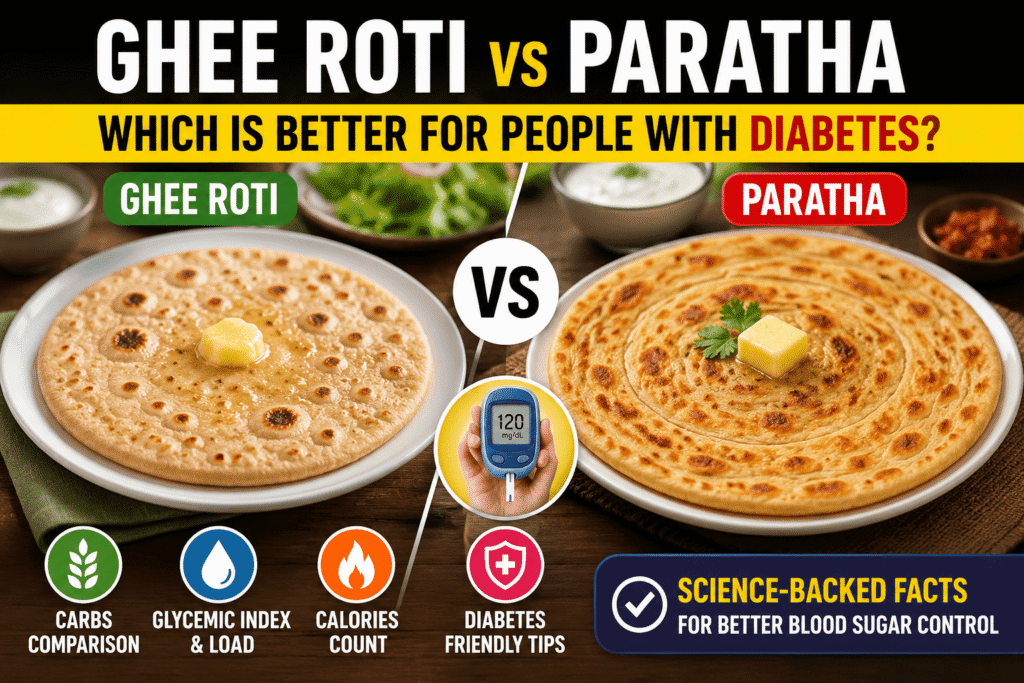
You may have also heard two completely different opinions. One person says, “Don’t eat paratha because it contains too much oil.” Another says, “Ghee slows digestion, so paratha won’t raise your blood sugar quickly.”
So, which one is actually better?
The answer is more interesting than simply saying “roti is good and paratha is bad.” When comparing ghee roti vs paratha for diabetes, we need to look at several things together, including carbohydrates, Glycemic Index (GI), Glycemic Load (GL), calories, fat, portion size, cooking method, and what you eat with the roti or paratha.
This article explains the difference in a practical way so you can make a more informed choice without completely giving up traditional foods.
Table of Contents
Important: The nutrition and GI/GL figures used in this article are estimates for comparison and education. Actual values can vary considerably depending on the flour, recipe, thickness, cooking method, amount of ghee or oil, and serving size. People with diabetes should consider their individual meal plan and glucose response.
What Is the Difference Between Plain Roti, Ghee Roti, and Paratha?
Before comparing them for diabetes, it helps to understand how these three foods are prepared.
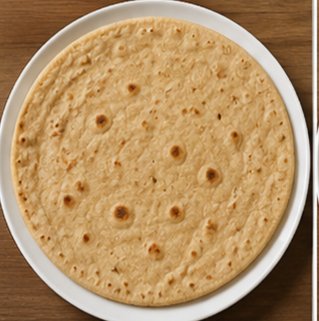
A plain roti is generally made from whole-wheat flour and water. The dough is rolled into a thin flatbread and cooked on a tawa or griddle, usually without adding significant amounts of oil or ghee.
A ghee roti is essentially a roti with a small amount of ghee applied after cooking. The amount can vary from a very thin coating to a much heavier layer.
A paratha is prepared differently. The dough is often rolled, folded, layered, and cooked with ghee or oil. Some recipes use fat between the layers and additional fat while cooking. As a result, paratha is generally more energy-dense than plain roti.
This difference matters because ghee and oil add calories and fat but do not remove the carbohydrate contained in the wheat flour.
That is one of the most important points to understand when discussing ghee roti vs paratha for diabetes.
Why Do Carbohydrates Matter in Diabetes?
Carbohydrates are the main macronutrient in roti and paratha that directly contributes to the rise in blood glucose after eating.
That does not mean people with diabetes must completely eliminate carbohydrates. The Centers for Disease Control and Prevention explains that carbohydrates can be part of a healthy diabetes eating pattern; the important factors are the type and amount of carbohydrate consumed.
Wheat flour contains starch, which is broken down during digestion into glucose. Therefore, whether you eat roti or paratha, the carbohydrate from the flour still needs to be considered.
The amount of carbohydrate you consume can become particularly important when you eat multiple rotis or a large paratha.
For example, eating one small roti and eating two large rotis are completely different situations, even though both foods are called “roti.”
This is why portion size is one of the most important considerations for people with diabetes. The CDC specifically recommends carbohydrate counting and portion control as useful tools for diabetes meal planning.
What Is the Glycemic Index?
The Glycemic Index, commonly called GI, describes how quickly a carbohydrate-containing food raises blood glucose compared with a reference food.
A food with a higher GI generally causes a faster rise in blood glucose than a food with a lower GI, although the actual response can vary from person to person.
For roti and paratha, GI should not be treated as a fixed number.
The GI can change depending on:
- The type of wheat or flour
- How finely the flour is milled
- The amount of fiber
- The thickness of the roti
- Cooking time and temperature
- Whether the food is eaten alone or with protein, fat, or vegetables
- The amount consumed
This is important because you may find different GI values for different types of roti and paratha in different sources.
For the purpose of our comparison, we have used illustrative estimated GI values of approximately 60 for plain whole-wheat roti, 58 for ghee roti, and 55 for whole-wheat paratha.
These figures should not be interpreted as laboratory-measured universal GI values for every roti or paratha.
Does Ghee Lower the Glycemic Index of Roti?
This is where many people become confused.
Adding fat to a carbohydrate-containing meal can affect the rate of digestion and gastric emptying. The presence of fat and protein can slow the rate at which carbohydrates are digested and absorbed, which may result in a slower rise in blood glucose.
The CDC similarly notes that eating carbohydrates together with foods containing protein, fat, or fiber can slow how quickly blood sugar rises.
However, this does not mean that adding large amounts of ghee makes a high-carbohydrate food automatically healthy for diabetes.
A small amount of ghee may alter the blood glucose response, but it also adds calories and saturated fat.
Therefore, the message should not be:
“Ghee lowers GI, so eat as much ghee as you want.”
A more accurate message is:
“Fat can slow digestion, but adding fat also increases the calorie content of the meal.”
That distinction is extremely important.
Ghee Roti vs Paratha: Glycemic Index Comparison
For our educational comparison, we can use the following estimated GI values:
| Food | Estimated GI |
| Plain whole-wheat roti | ~60 |
| Ghee roti | ~58 |
| Whole-wheat paratha | ~55 |
These numbers suggest that the difference in GI between the three foods may be relatively small.
The important point is that a slightly lower GI does not automatically make a food healthier.
For example, if a paratha contains substantially more fat and calories than a plain roti, eating a large portion may create a different nutritional problem even if its estimated GI is somewhat lower.
GI is therefore only one part of the picture.
What Is Glycemic Load?
For Low Glycemic Load meal plan, click here
This is where the comparison becomes much more useful.
Glycemic Load, or GL, takes both the GI of a food and the amount of available carbohydrate in the serving into account.
A commonly used calculation is:
GL = GI × available carbohydrate in the serving ÷ 100
This means that a food can have a moderate GI but still produce a high GL if you eat a large amount.
This is exactly why portion size matters when discussing roti and paratha.
The CDC also emphasizes that people with diabetes should consider the amount of carbohydrate they consume and use portion control as part of meal planning.
Glycemic Load of Roti, Ghee Roti, and Paratha with Different Serving Size
Using the estimated carbohydrate and GI assumptions from our comparison, the approximate GL values are:
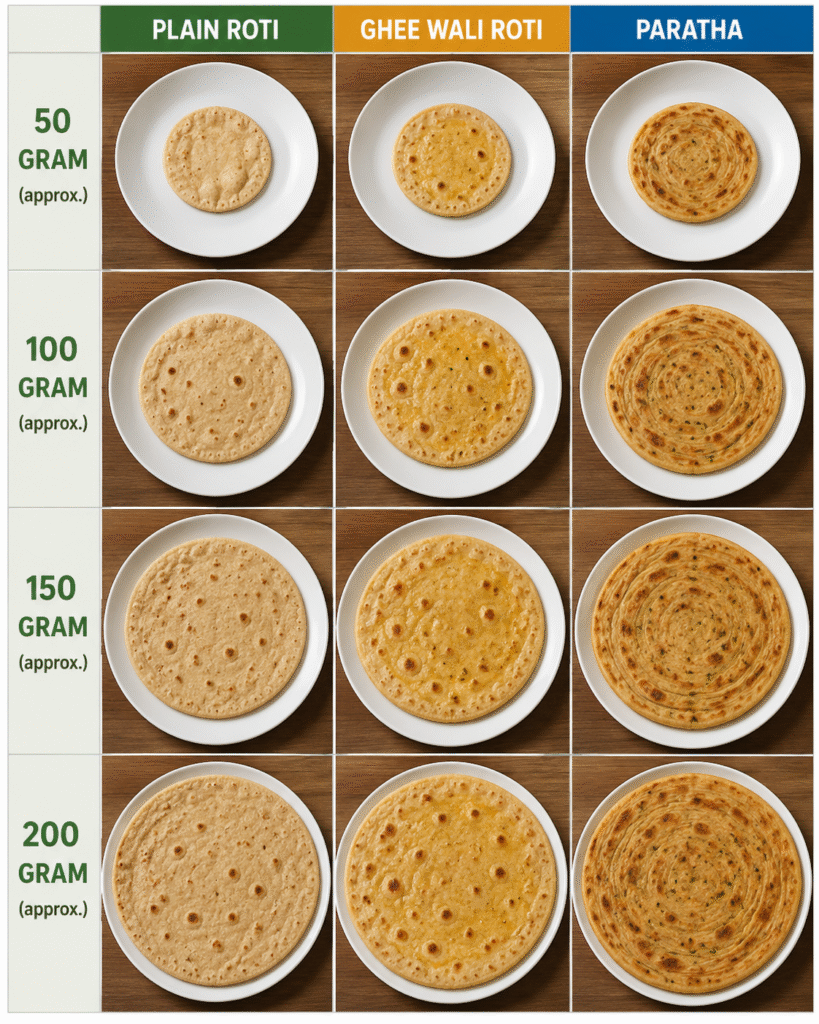
| Serving Size | Plain Roti GL | Ghee Roti GL | Whole-Wheat Paratha GL |
| 50 g | 12.9 | 11.6 | 10.2 |
| 100 g | 25.8 | 23.2 | 20.4 |
| 150 g | 38.7 | 34.8 | 30.5 |
| 200 g | 51.6 | 46.4 | 40.7 |
At first glance, the table seems to suggest that paratha is the winner.
But there is an important catch.
These are equal-weight comparisons.
In other words, we are comparing 50 grams of each food with 50 grams of the other foods, then 100 grams with 100 grams, and so on.
That is not necessarily how people eat these foods in real life.
Why Does Paratha Have a Lower GL Per 100 g in This Comparison?
The answer is simple: fat contains calories but essentially no carbohydrate.
When more ghee or oil is incorporated into a paratha, part of the food’s weight comes from fat rather than carbohydrate.
Therefore, if you compare 100 grams of plain roti with 100 grams of a richer paratha, the paratha may contain fewer grams of carbohydrate per 100 grams.
If its estimated GI is also slightly lower, the calculated GL will be lower.
But that does not mean that paratha is necessarily the better choice.
This is one of the most important lessons from the entire comparison.
A lower GL per 100 grams does not automatically mean lower calories, lower fat, or better overall nutritional quality.
Calories: Where the Difference Becomes More Important
Now let’s move from GI and GL to calories.
For our illustrative comparison, the approximate calorie values are:
| Serving Size | Plain Roti | Ghee Roti | Whole-Wheat Paratha |
| 50 g | 120 kcal | 160 kcal | 150 kcal |
| 100 g | 240 kcal | 320 kcal | 300 kcal |
| 150 g | 360 kcal | 480 kcal | 450 kcal |
| 200 g | 480 kcal | 640 kcal | 600 kcal |
Again, these are estimates, not universal laboratory values. Homemade recipes can vary substantially.
The amount of ghee or oil is particularly important.
A roti with a very thin layer of ghee will be very different from a roti soaked in ghee.
Likewise, a lightly cooked paratha made with a small amount of oil will be different from a restaurant-style paratha containing several tablespoons of fat.
This is why you should always consider how the food was actually prepared, rather than relying on the food’s name alone.
Carbohydrates in Roti vs Paratha
Carbohydrates are another important part of the comparison.
For our illustrative calculations, we used approximate available carbohydrate values per 100 grams of:
- Plain roti: about 43 g
- Ghee roti: about 40 g
- Whole-wheat paratha: about 37 g
Again, these figures can vary significantly.
The actual carbohydrate content depends on how much flour was used to make the food and how much water and fat are present in the cooked product.
For example, two parathas can have completely different carbohydrate contents if one is made with 60 grams of flour and another is made with 100 grams of flour.
Therefore, weighing the finished food alone does not always tell you exactly how much carbohydrate you consumed.
The flour quantity used in the recipe matters too.
Is Paratha Bad for People With Diabetes?
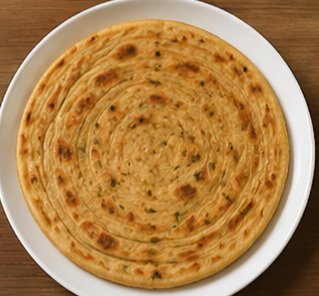
Not necessarily.
People with diabetes do not necessarily have to completely eliminate paratha.
The better question is:
How much paratha are you eating, how often are you eating it, how much fat is used to prepare it, and what else is on your plate?
A small, homemade whole-wheat paratha prepared with a controlled amount of oil or ghee can potentially fit into an individualized diabetes meal plan.
The problem usually comes when a large paratha is combined with several other calorie-dense foods.
For example, consider a breakfast containing a large paratha, sweetened tea, sugary yogurt, and a high-calorie side dish.
The problem is no longer simply “paratha.”
The entire meal may contain a large amount of carbohydrate, fat, and calories.
A more balanced breakfast could contain a smaller portion of whole-wheat roti or paratha combined with a protein source and non-starchy vegetables.
The CDC recommends using a plate-based approach that emphasizes non-starchy vegetables, lean protein, and an appropriate portion of carbohydrate foods.
Can People With Diabetes Eat Ghee?
Ghee does not contain carbohydrate, so it does not directly raise blood glucose in the same way that carbohydrate-containing foods do.
But that does not mean unlimited ghee is appropriate.
Ghee is a concentrated source of fat and calories. Excess calorie intake can make weight management more difficult.
For people with diabetes, overall dietary quality and weight management can be important parts of long-term health. The CDC recommends choosing foods lower in calories and saturated fat when appropriate and maintaining a healthy weight.
So the practical message is simple:
A small amount of ghee can be included in a balanced diet, but more ghee is not automatically better.
Why Portion Size May Matter More Than the Food Name
One of the biggest mistakes people make when thinking about diabetes-friendly foods is focusing entirely on whether a food is “good” or “bad.”
The same food can produce very different results depending on the amount consumed.
Consider two situations.
In the first situation, someone eats one small roti with vegetables, eggs, and plain yogurt.
In the second situation, someone eats two very large parathas with a sugary drink.
Both meals contain wheat-based flatbread, but their overall carbohydrate, fat, calorie, and nutritional profiles are very different.
This is why portion control is central to diabetes meal planning.
The CDC explains that portion size can have an important effect on food intake and recommends practical approaches such as the plate method.
What Is the Best Portion of Roti for Diabetes?
There is no single roti size that is appropriate for every person with diabetes.
Your carbohydrate needs depend on factors such as your body size, activity level, medications, glucose targets, and overall meal plan.
The CDC specifically notes that there is no universal carbohydrate target that applies to everyone.
Therefore, rather than saying “every diabetic should eat exactly one roti,” it is better to think in terms of an individualized carbohydrate budget.
For someone who has been advised to eat a certain amount of carbohydrate at a meal, the roti or paratha needs to fit into that total.
This is particularly important if the meal also includes rice, potatoes, beans, fruit, milk, or other carbohydrate-containing foods.
How to Make Roti More Diabetes-Friendly
If you enjoy roti and want to make it more suitable for blood sugar management, there are several practical strategies.
First, consider using whole-wheat flour rather than highly refined flour.
Second, pay attention to the thickness and size of the roti.
Third, avoid turning a moderate carbohydrate food into a very high-calorie meal by adding large amounts of ghee.
Fourth, pair your roti with protein and non-starchy vegetables.
For example, you could combine one roti with eggs, chicken, fish, lentils in an appropriate portion, plain yogurt, salad, spinach, cauliflower, okra, or other non-starchy vegetables.
Fiber-rich foods can also support blood sugar management and help with fullness. The CDC notes that fiber can support blood sugar control and weight management.
How to Make Paratha More Diabetes-Friendly
If you don’t want to give up paratha completely, portion control is your most useful tool.
Instead of making a very large, heavily fried paratha, consider making a smaller paratha with a controlled amount of oil or ghee.
You can also pair it with protein and vegetables instead of combining it with multiple high-carbohydrate foods.
For example, a smaller homemade paratha with an egg and a serving of non-starchy vegetables is a very different meal from two large parathas with sweetened tea.
The goal is not necessarily to remove every traditional food from your diet.
The goal is to create a meal pattern that allows you to enjoy familiar foods while keeping carbohydrate portions, calories, and overall nutrition under control.
Ghee Roti vs Paratha for Weight Management
Weight management deserves special attention because diabetes and excess body weight often interact in ways that can make blood sugar management more challenging.
If a person regularly consumes more calories than their body needs, weight gain can occur.
Roti itself is not automatically responsible for weight gain. The same is true for paratha.
The issue is the overall calorie balance and eating pattern.
However, because paratha is commonly prepared with more oil or ghee, it can be easier to consume a large number of calories without realizing it.
This is one reason plain roti can be a more practical everyday option for someone trying to manage calorie intake.
The CDC emphasizes healthy eating patterns, physical activity, and weight management as important parts of overall diabetes care.
What Should You Eat With Roti or Paratha?
The food you eat alongside your roti or paratha can make a major difference.
Instead of thinking about the flatbread in isolation, think about the whole plate.
A balanced meal could include:
A controlled portion of roti or paratha, plus a protein source, plus plenty of non-starchy vegetables.
Good protein options may include eggs, fish, chicken, plain yogurt, or appropriate portions of legumes.
Vegetable options can include spinach, cauliflower, cucumber, tomato, okra, cabbage, eggplant, peppers, or mixed vegetables.
This approach is consistent with the CDC’s plate method, which recommends filling about half the plate with non-starchy vegetables, one quarter with lean protein, and one quarter with carbohydrate foods.
What About Roti With Ghee and Eggs?
This can be a practical breakfast combination for some people.
The egg provides protein, while the roti provides carbohydrate.
If you add ghee, keep the quantity controlled because ghee increases calories.
For example, a small whole-wheat roti with a thin layer of ghee, an egg, and vegetables may be more balanced than a large paratha eaten alone.
But individual glucose responses differ.
If you use a blood glucose meter or continuous glucose monitor, your readings can help you understand how your body responds to particular meals.
Your healthcare professional or diabetes educator can help you interpret those readings and adjust your meal plan appropriately.
What About Paratha With Yogurt?
Plain unsweetened yogurt can be a useful accompaniment to a meal because it provides protein and other nutrients.
However, be careful with sweetened yogurt or yogurt-based drinks that contain added sugar.
A common mistake is to eat a large paratha and then add a sugary drink, sweet tea, or sweetened yogurt.
The combination can substantially increase the carbohydrate content of the meal.
Choosing water or another unsweetened beverage is generally a simpler option for blood sugar management. The CDC recommends water instead of sugary drinks as part of healthy diabetes management.
Does a Lower GI Mean Paratha Is Healthier?
No.
This is perhaps the most important conclusion from the entire comparison.
GI tells us about the relative speed of the blood glucose response to a carbohydrate-containing food under standardized testing conditions.
It does not tell us everything about the food.
It does not tell you how many calories the food contains.
It does not tell you how much saturated fat it contains.
It does not tell you how large your serving will be.
And it does not tell you what else you are going to eat with it.
Therefore, if a paratha has a slightly lower estimated GI than plain roti, that does not automatically make it the healthier choice.
You need to look at the whole nutritional picture.
GI vs GL: Which One Should a Person With Diabetes Focus On?
Both can be useful, but neither should be considered in isolation.
GI focuses on the rate at which available carbohydrate raises blood glucose.
GL incorporates both the GI and the amount of carbohydrate consumed.
That makes GL particularly useful when comparing different portion sizes.
For example, a small portion of a moderate-GI food may have a relatively modest GL, while a very large portion of the same food can produce a much higher GL.
This is why the 50 g, 100 g, 150 g, and 200 g comparison is useful for demonstrating an important principle:
As the portion gets larger, the calculated glycemic load increases.
However, remember that the exact GL of a homemade roti or paratha cannot be known precisely without standardized laboratory testing of that particular preparation.
What About Blood Sugar After Eating Roti or Paratha?
The actual blood glucose response can vary from one person to another.
Two people can eat the same paratha and experience different glucose responses.
Factors that can influence the response include:
- The person’s insulin sensitivity
- Diabetes medications
- Physical activity
- Previous meal
- Time of day
- Portion size
- Type of flour
- Cooking method
- Fiber content
- Protein and fat in the meal
- Individual metabolism
This is why nutrition advice for diabetes should not rely on one number alone.
The CDC recommends tracking blood glucose to understand what causes it to rise or fall and working with a healthcare team on individualized targets.
Plain Roti vs Ghee Roti vs Paratha: Which One Wins?
If our primary goal is lower calorie intake, plain roti generally has an advantage.
If we want the taste of ghee, a small amount of ghee on roti can be incorporated into a balanced meal, provided the total calorie and fat intake remains appropriate.
Paratha can still be eaten occasionally, particularly when prepared at home with a controlled amount of oil or ghee and consumed in an appropriate portion.
The biggest mistake would be to interpret a slightly lower GI or GL as permission to eat unlimited paratha.
Instead, think of the three options this way:
Plain roti: generally the simplest and lowest-calorie everyday option.
Ghee roti: similar carbohydrate base but higher calories because of the added ghee.
Paratha: often higher in fat and calories because of the preparation method, so portion control becomes especially important.
A Practical Diabetes-Friendly Breakfast
Let’s turn all of this information into a practical example.
Imagine you are preparing breakfast.
Instead of eating a very large paratha with sweetened tea, you could choose a smaller whole-wheat roti or a modest homemade paratha.
Then add an egg or another protein source.
Add cucumber, tomato, spinach, or another non-starchy vegetable.
Choose plain unsweetened yogurt if it fits your meal plan.
Drink water or an unsweetened beverage.
This type of meal provides a more balanced combination of carbohydrate, protein, fiber, and fat.
The CDC’s diabetes meal-planning guidance similarly emphasizes balanced meals, appropriate portions, non-starchy vegetables, lean protein, and controlled carbohydrate foods.
Common Myths About Ghee Roti and Paratha
Myth 1: “Ghee does not affect diabetes, so I can eat unlimited ghee.”
Ghee contains little or no carbohydrate, but it is calorie-dense fat. Large amounts can increase total calorie intake.
Myth 2: “Paratha has a lower GI, so it is better than roti.”
A lower GI does not automatically mean better overall nutrition. Calories, fat, carbohydrate quantity, portion size, and the rest of the meal matter.
Myth 3: “Whole-wheat means I can eat as much as I want.”
Whole-wheat foods can provide more fiber and nutrients than refined grains, but they still contain carbohydrate and calories.
Myth 4: “People with diabetes should never eat roti.”
Not necessarily. Roti can fit into a balanced diabetes meal plan. The important considerations are the type, portion, and overall meal.
Myth 5: “If a food doesn’t taste sweet, it won’t raise blood sugar.”
This is incorrect. Foods containing starch, including wheat-based foods, can raise blood glucose even when they do not taste sweet.
How Many Rotis Can a Person With Diabetes Eat?
There is no universal number.
One person’s appropriate portion may be different from another person’s because carbohydrate requirements vary according to body size, activity, medication, glucose targets, and other factors.
Instead of asking only, “How many rotis can a diabetic eat?” a better question is:
“How much carbohydrate should I have at this meal, and how much of that carbohydrate is coming from my roti?”
The CDC specifically states that there is no one-size-fits-all carbohydrate target and recommends working with a healthcare team to determine appropriate goals.
Should You Completely Avoid Paratha?
For most people, completely banning a favorite food is not necessarily the best long-term strategy.
A sustainable eating pattern is often easier to maintain when it allows reasonable flexibility.
If you enjoy paratha, you can focus on:
smaller portions, less added fat, whole-wheat ingredients, balanced side dishes, and less frequent consumption.
This approach is more realistic than believing that you must never eat paratha again.
The goal of diabetes nutrition is not simply to identify foods as “allowed” or “forbidden.” The goal is to create a sustainable eating pattern that supports blood glucose management, healthy weight, adequate nutrition, and quality of life.
Final Verdict: Ghee Roti vs Paratha for Diabetes
So, ghee roti vs paratha for diabetes—which is better?
If we compare the foods at the same weight, our illustrative calculations show that paratha can have a slightly lower calculated Glycemic Load because its higher fat content means fewer grams of carbohydrate per 100 grams of the finished food.
But this does not make paratha the healthier choice.
When we consider calories, fat, typical serving size, and the overall meal, plain whole-wheat roti is generally the more practical everyday option for someone trying to control calorie intake and blood sugar.
A roti with a small amount of ghee can also fit into a balanced meal.
Paratha does not necessarily have to be completely avoided, but it is better treated as an occasional or controlled-portion food rather than something to eat freely every day, particularly when it is prepared with large amounts of ghee or oil.
The most important lesson is this:
Don’t judge a food only by its Glycemic Index. Look at the carbohydrate amount, Glycemic Load, calories, fat, portion size, preparation method, and the entire meal.
For people with diabetes, the best choice is usually not about finding one “magic” bread. It is about building a balanced eating pattern that you can maintain over the long term.
If you enjoy traditional Pakistani and South Asian foods, you do not necessarily have to give them up. Instead, learn how to control the portion, ingredients, cooking method, and meal combination.
And remember, your individual blood glucose response matters. If you have diabetes, work with your doctor or registered dietitian to determine the carbohydrate and calorie targets that are appropriate for you, particularly if you use insulin or glucose-lowering medication.
In conclusion, when choosing between ghee roti and paratha for diabetes, plain whole-wheat roti is generally the better everyday choice because it can provide a simpler, lower-calorie way to include carbohydrates in a balanced meal. A lightly ghee-coated roti can also be reasonable when the amount of ghee is controlled. Paratha can be enjoyed occasionally, but its higher fat and calorie content makes portion control especially important. The goal is not to fear roti or paratha—it is to understand carbohydrates, portions, calories, and your own blood sugar response so that you can make smarter choices every day.