
If you have diabetes and enjoy something sweet in the evening, you may have wondered: Are grapes or raisins better for blood sugar?
At first glance, the answer may seem obvious. Grapes and raisins come from the same fruit, so it is easy to assume that they should have almost the same nutritional effect.

But there is an important difference.
Raisins are grapes with most of their water removed. When water is removed, the natural sugars, carbohydrates, calories, and other nutrients become much more concentrated.
This means that comparing grapes and raisins by the same weight can produce a surprisingly large difference in calories and carbohydrate content.
So, when it comes to grapes vs raisins for diabetes, the question is not simply whether one food is “good” and the other is “bad.” The more useful questions are:
- How much are you eating?
- How many carbohydrates does the portion contain?
- What is the estimated glycemic load?
- How does your blood glucose respond?
- Are you eating the fruit as part of an overall balanced meal or snack?
In this article, we will compare grapes and raisins for diabetes, including carbohydrates, natural sugar, calories, water content, glycemic load, portion size, and practical ways to include them in a diabetes-friendly eating pattern.
Table of Contents
Grapes vs Raisins for Diabetes: The Basic Difference
Fresh grapes contain a large amount of water. According to USDA food-composition data, raw grapes contain roughly 80% water by weight.
Raisins are produced by drying grapes, which removes most of that water.
The fruit does not suddenly create more sugar during drying. Instead, the existing nutrients become concentrated into a much smaller and denser food.
That is why 100 grams of raisins contain far more calories and carbohydrates than 100 grams of fresh grapes.
This distinction is particularly important for people with diabetes because portion size and carbohydrate intake matter when managing blood glucose.
A person may comfortably eat a relatively large volume of fresh grapes, while a much smaller volume of raisins can provide a similar or greater amount of carbohydrate.
Grapes vs Raisins Nutrition Comparison
Let’s first compare the basic nutritional composition of fresh grapes and raisins.
The following values are approximate and can vary depending on grape variety, processing, moisture content, and the specific food product.
| Nutrient | Fresh Grapes, 100 g | Raisins, 100 g |
|---|---|---|
| Calories | ~69 kcal | ~299 kcal |
| Carbohydrates | ~18.1 g | ~79.3 g |
| Total sugars | ~15.5 g | ~59.2 g |
| Protein | ~0.7 g | ~3.1 g |
| Water | ~80.5 g | ~15.5 g |
| Potassium | ~191 mg | ~744 mg |
| Calcium | ~10 mg | ~50 mg |
| Iron | ~0.4 mg | ~1.9 mg |
The nutritional values above are based on USDA food-composition data and are intended as approximate reference values rather than measurements for every variety of grapes or raisins.
The biggest differences are immediately obvious.
Raisins are much more calorie-dense and carbohydrate-dense than fresh grapes.
That does not make raisins an unhealthy food. It simply means that the amount you eat becomes particularly important.
Why Do Raisins Have More Carbohydrates Than Grapes?
This is one of the most important concepts when discussing grapes vs raisins for diabetes.
Imagine taking a bowl of fresh grapes and removing most of the water.
The remaining fruit becomes smaller, lighter, and much more concentrated.
The carbohydrates and natural sugars are still there, but they are packed into a smaller amount of food.
For example, approximately 100 grams of fresh grapes contain about 18 grams of carbohydrates.
In contrast, approximately 100 grams of raisins contain around 79 grams of carbohydrates.
So the difference is not because raisins are artificially loaded with sugar.
It is mainly because drying removes water and concentrates the nutrients.
This is similar to the difference between eating a large amount of fresh fruit and eating the same fruit after it has been dried.
Grapes vs Raisins: Calories Compared
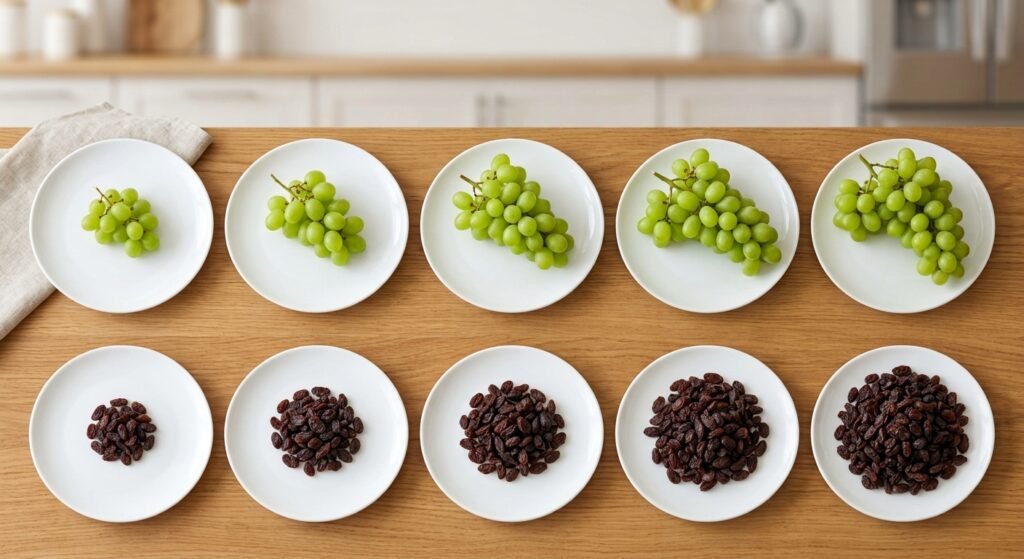
Calories are another major difference.
Approximately 100 grams of fresh grapes provide around 69 calories, whereas 100 grams of raisins provide around 299 calories.
That means raisins provide more than four times as many calories per 100 grams.
This matters particularly for people who are trying to manage their body weight as well as blood glucose.
However, there is an important point to remember.
Most people do not eat 100 grams of raisins in one sitting.
A realistic serving of raisins is much smaller.
The problem can occur when someone eats raisins directly from a large packet or container. Because raisins are small and easy to eat quickly, it can be surprisingly easy to consume a large portion without realizing how much carbohydrate has been eaten.
Glycemic Load of Grapes vs Raisins
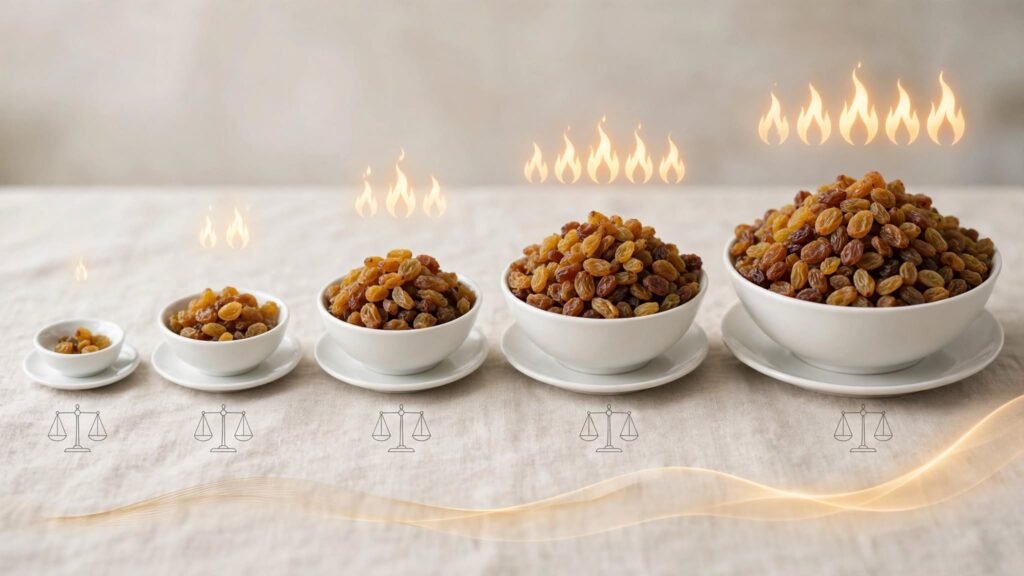
When discussing grapes vs raisins for diabetes, glycemic load can provide additional context.
The glycemic index, or GI, describes how quickly a carbohydrate-containing food raises blood glucose relative to a reference food.
However, GI alone does not tell us how much carbohydrate is actually being consumed in a normal serving.
This is where glycemic load (GL) becomes useful.
A commonly used formula is:
Glycemic Load = GI × available carbohydrate in the serving ÷ 100
The American Diabetes Association’s literature describes glycemic load as incorporating both the glycemic index and the amount of carbohydrate in a food portion.
Therefore, a food can have a relatively moderate GI but still produce a substantial glycemic load if the serving contains a large amount of carbohydrate.
Estimated Glycemic Load Comparison
Using commonly cited GI estimates, the following table illustrates how the glycemic load can increase with portion size.
| Serving | Fresh Grapes: Approx. GL | Raisins: Approx. GL |
|---|---|---|
| 50 g | ~5.4 | ~20.6 |
| 100 g | ~10.7 | ~41.2 |
| 150 g | ~16.0 | ~61.8 |
| 200 g | ~21.4 | ~82.4 |
| 250 g | ~26.7 | ~103.0 |
Important: These are calculated estimates rather than universal laboratory measurements for every grape or raisin. Actual GI and GL can vary according to variety, ripeness, processing, and testing conditions. Published GI research also shows that food GI values are not perfectly fixed across all foods and circumstances.
The table nevertheless demonstrates an important nutritional principle:
As the portion becomes larger, the carbohydrate load becomes larger.
And because raisins contain substantially more carbohydrate per gram, their estimated glycemic load rises much faster.
Is Raisin Sugar Worse Than Grape Sugar?

Not necessarily.
This is an important distinction.
The sugar naturally present in raisins is not automatically “bad sugar,” and the sugar in grapes is not automatically harmless simply because grapes contain more water.
Both foods contain naturally occurring sugars.
The key issue for someone with diabetes is the total amount of carbohydrate consumed and the portion size.
A small amount of raisins can fit into an overall balanced diet, while a very large serving of grapes can also contribute a significant carbohydrate load.
So rather than asking:
“Is raisin sugar bad?”
A more useful question is:
“How much carbohydrate am I getting from this portion?”
That approach makes the comparison more practical.
Are Grapes Good for People With Diabetes?
Fresh grapes can be included in a diabetes-friendly eating pattern for many people.
They provide water, carbohydrates, natural sugars, and micronutrients. They are also relatively low in calories compared with many dried fruits.
However, “healthy fruit” does not mean “unlimited fruit.”
A person with diabetes can still experience a rise in blood glucose after eating a large amount of grapes.
The important factor is portion size and the individual’s overall carbohydrate intake.
Some people may tolerate a particular serving of grapes well, while others may see a larger glucose response.
This is one reason monitoring your own blood glucose response can be useful.
Are Raisins Bad for People With Diabetes?
No. It would be too simplistic to call raisins a “bad food” for people with diabetes.
Raisins contain several nutrients, including potassium and iron, and they can be part of a balanced eating pattern.
The main issue is their high carbohydrate and calorie concentration.
Because raisins contain much less water than fresh grapes, a relatively small volume can contain a substantial amount of carbohydrate.
For someone with diabetes, this means portion control becomes particularly important.
Instead of eating raisins by the handful without measuring the amount, it may be better to use a small, deliberate portion and account for the carbohydrates within the overall meal or snack.
How Many Grapes Can a Person With Diabetes Eat?

There is no single grape serving that is appropriate for every person with diabetes.
Your appropriate portion depends on factors such as your overall diet, medication, activity level, blood glucose targets, and individual response to carbohydrates.
As a practical starting point, a small portion of fresh grapes may be easier to incorporate into a meal or snack than eating a very large bowl at once.
For example, you could start with around 50–100 grams of grapes, then observe how your blood glucose responds.
This is not a universal prescription. Your individual diabetes management plan should take priority.
If you regularly monitor glucose after meals, comparing your response to different portions can provide useful personal information.
How Many Raisins Can a Person With Diabetes Eat?

The same principle applies to raisins, but portion control becomes even more important because raisins are much more concentrated.
Instead of taking a large handful directly from the packet, consider measuring a small portion.
For example, 20–30 grams of raisins can be considerably different from eating 100 grams.
Using approximately 79 grams of carbohydrate per 100 grams, 20 grams of raisins would provide roughly 16 grams of carbohydrate, while 30 grams would provide roughly 24 grams.
These are approximate calculations, and the carbohydrate content can vary between products.
The important lesson is:
A small portion of raisins can be very different from a large handful.
50 Grams of Grapes vs 50 Grams of Raisins
The difference becomes easier to understand when we compare equal weights.
50 grams of fresh grapes
Approximately:
- 35 calories
- 9 grams carbohydrates
- Around 5.4 estimated glycemic load
50 grams of raisins
Approximately:
- 150 calories
- Nearly 40 grams carbohydrates
- Around 20.6 estimated glycemic load
So, although both portions weigh exactly 50 grams, their nutritional impact can be very different.
This is one of the strongest reasons why grapes vs raisins for diabetes is an important comparison.
100 Grams of Grapes vs 100 Grams of Raisins
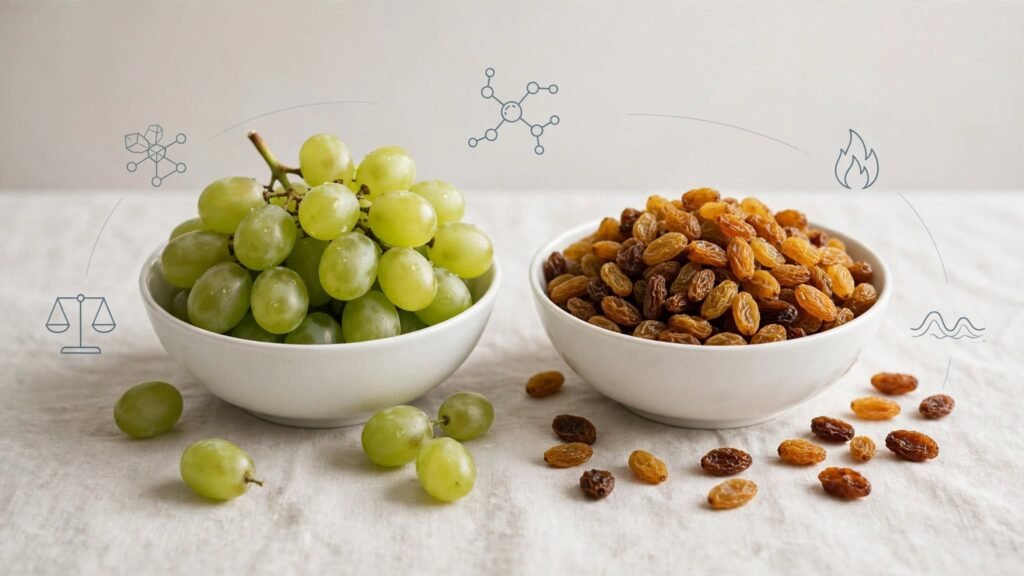
At 100 grams, the difference becomes even clearer.
| Nutrient / Measure | 100 g Grapes | 100 g Raisins |
|---|---|---|
| Calories | ~69 | ~299 |
| Carbohydrates | ~18.1 g | ~79.3 g |
| Sugars | ~15.5 g | ~59.2 g |
| Water | ~80.5 g | ~15.5 g |
| Estimated GL | ~10.7 | ~41.2 |
This comparison demonstrates why dried fruit requires more attention to portion size.
You can eat a relatively large volume of fresh grapes while consuming less carbohydrate than the same weight of raisins.
Why Portion Size Matters More Than “Good” or “Bad”
One of the most common mistakes in diabetes nutrition is dividing foods into two categories: “good foods” and “bad foods.”
Real-world nutrition is usually more complicated.
A food can be nutritious but still provide a significant amount of carbohydrate.
A food can also be calorie-dense without being inherently unhealthy.
For grapes and raisins, the more useful concept is portion control.
Consider these two situations:
Situation 1: A person eats a controlled portion of raisins alongside an otherwise balanced snack.
Situation 2: A person continuously eats raisins from a large packet while watching television.
The food is the same, but the total amount consumed can be completely different.
That difference can have a major effect on total carbohydrate and calorie intake.
Can You Eat Raisins and Grapes on the Same Day?
For many people with diabetes, there is no general rule that says you must completely avoid both foods on the same day.
However, eating both in large portions could substantially increase your total carbohydrate intake.
If you want to include both, keep the portions controlled and consider your overall meal plan.
For example, instead of eating a large serving of grapes and a large serving of raisins as separate snacks, you could use a smaller portion of one as part of a balanced snack.
The goal is not necessarily to eliminate fruit.
The goal is to understand how much carbohydrate you are consuming.
Should You Choose Grapes or Raisins for Diabetes?
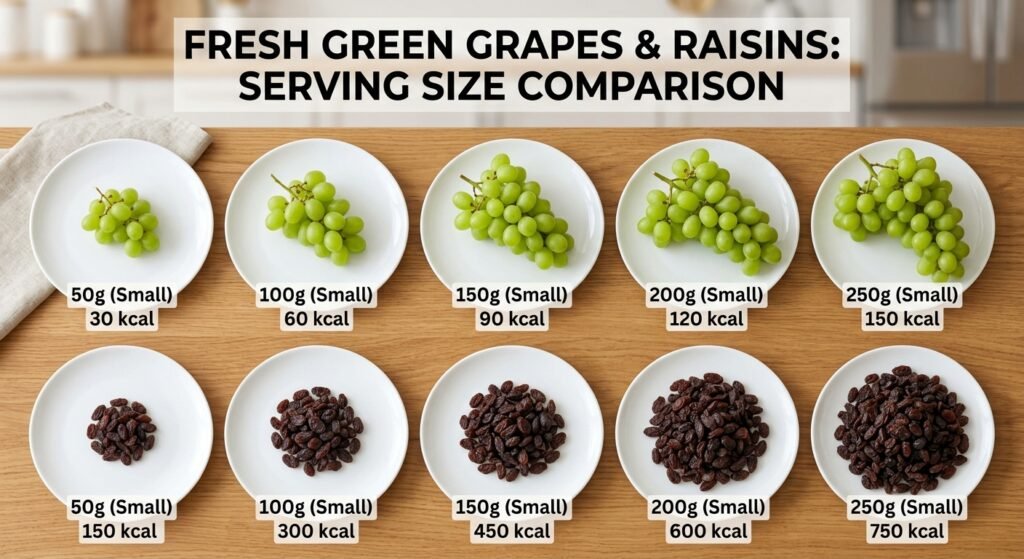
If your main concern is getting more food volume with fewer calories and less concentrated carbohydrate, fresh grapes are generally the easier option.
Their high water content means they are much less calorie-dense than raisins.
Raisins can still be included, but they require more attention to portion size.
Therefore, if you are choosing between a bowl of fresh grapes and an equivalent weight of raisins, fresh grapes will generally provide substantially fewer calories and carbohydrates.
But that does not mean raisins are forbidden.
A small portion may fit into your eating pattern.
A Simple Diabetes-Friendly Approach
If you have diabetes and enjoy grapes or raisins, try this simple approach:
First, control the portion.
Do not rely on a large handful as your measurement.
Second, consider the carbohydrate content.
Remember that dried fruit is much more concentrated than fresh fruit.
Third, avoid treating fruit as completely carbohydrate-free.
Natural fruit sugar still contributes to total carbohydrate intake.
Fourth, consider what you eat with it.
A balanced snack may contain a combination of foods rather than a large portion of dried fruit by itself.
Finally, monitor your own response when appropriate.
If your healthcare professional has recommended blood glucose monitoring, checking your response after different portions can help you understand your personal tolerance.
Frequently Asked Questions About Grapes vs Raisins for Diabetes
Are grapes better than raisins for diabetes?
Fresh grapes are generally less calorie-dense and contain considerably fewer carbohydrates per 100 grams than raisins. Therefore, grapes may be easier to fit into a diabetes-friendly eating pattern when comparing equal weights.
Can diabetics eat raisins?
Yes, raisins can be eaten by many people with diabetes, but portion size is important because raisins are concentrated in carbohydrates and calories.
Do raisins raise blood sugar?
Raisins contain a substantial amount of carbohydrate, so they can raise blood glucose. The response depends on the portion eaten, the rest of the meal, and the individual’s glucose response.
Are grapes high in sugar?
Grapes contain naturally occurring sugar, but they also contain a large amount of water. Approximately 100 grams of grapes contain around 15.5 grams of total sugars.
How many raisins can a diabetic eat?
There is no universal number that applies to everyone. A small measured portion, such as 20–30 grams, contains considerably less carbohydrate than 100 grams. The appropriate amount depends on your overall diet and individual diabetes management plan.
How many grapes can a diabetic eat?
There is no single correct number for every person. A small serving such as 50–100 grams can be a practical starting point for many people, but individual carbohydrate requirements and blood glucose responses vary.
Which has more calories, grapes or raisins?
Raisins have substantially more calories per 100 grams. Fresh grapes provide approximately 69 calories per 100 grams, while raisins provide approximately 299 calories.
Which has more carbohydrates, grapes or raisins?
Raisins contain substantially more carbohydrates per 100 grams. Fresh grapes contain approximately 18.1 grams of carbohydrates per 100 grams, compared with roughly 79.3 grams in raisins.
Is dried fruit worse than fresh fruit for diabetes?
Not necessarily. Dried fruit can still provide nutrients, but the removal of water makes it much more concentrated. Therefore, portion control is particularly important with dried fruit.
Should people with diabetes completely avoid raisins?
Not necessarily. Diabetes does not automatically mean that raisins must be completely eliminated. The more important considerations are portion size, total carbohydrate intake, overall dietary pattern, and individual blood glucose response.
Final Thoughts: Grapes vs Raisins for Diabetes
The biggest lesson from this comparison is simple: grapes and raisins come from the same fruit, but they are not nutritionally identical by weight.
Fresh grapes contain a large amount of water, making them relatively low in calories and less concentrated in carbohydrates.
Raisins contain very little water because the grapes have been dried. As a result, their natural sugars and carbohydrates become much more concentrated.
That is why 100 grams of raisins can provide several times more calories and carbohydrates than 100 grams of fresh grapes.
For people with diabetes, this does not mean that raisins are automatically forbidden or that grapes can be eaten without limits.
Instead, the better approach is to focus on portion size, total carbohydrate intake, and your individual blood glucose response.
If you enjoy grapes, a controlled serving of fresh grapes may be an easier choice when you want more food volume with fewer calories and less concentrated carbohydrate.
If you enjoy raisins, you do not necessarily need to eliminate them. Just remember that a small measured portion can be very different from eating a large handful.
Ultimately, when it comes to grapes vs raisins for diabetes, the question should not simply be, “Which fruit is good and which one is bad?”
The better question is:
“How much am I eating, how much carbohydrate does that portion contain, and how does my body respond to it?”
That is a much more practical approach to including fruit while managing blood sugar.