
Managing blood sugar is not just about checking glucose once or twice a day. For people living with diabetes, prediabetes, or even those at risk, the real picture of blood sugar control is reflected over weeks and months—not hours. This is where HbA1c becomes one of the most important indicators of metabolic health.
Estimated HbA1c Calculator
However, laboratory HbA1c tests are usually done every 3 months, which means many people remain unaware of whether their daily habits are improving or worsening their condition. To bridge this gap, tools like an Estimated HbA1c Calculator play a powerful educational and monitoring role.
Table of Contents
In this comprehensive guide, you’ll learn what HbA1c is, how an estimated HbA1c calculator works, how to interpret your results, and how this calculator can help you take better control of your health—all explained in simple, human language.
What Is HbA1c and Why Is It Important for Diabetes Management?
HbA1c, also known as glycated hemoglobin, measures the percentage of hemoglobin in your blood that has glucose attached to it. Since red blood cells live for about 120 days, HbA1c reflects your average blood glucose level over the past 2–3 months.
Unlike fasting or post-meal glucose readings, HbA1c:
- Is not affected by daily fluctuations
- Does not change dramatically in one day
- Reflects long-term glycemic exposure
Why Doctors Rely on HbA1c
Doctors use HbA1c to:
- Diagnose diabetes and prediabetes
- Monitor long-term glucose control
- Adjust treatment plans
- Predict the risk of diabetes-related complications
HbA1c vs daily glucose testing
| Feature | Daily Glucose Test | HbA1c |
| Shows short-term changes | ✅ | ❌ |
| Reflects long-term control | ❌ | ✅ |
| Influenced by meals & stress | ✅ | ❌ |
| Used for diagnosis | ❌ | ✅ |
This makes HbA1c a gold standard marker in diabetes care.
Understanding the Difference Between HbA1c and Daily Glucose Testing
Daily blood glucose testing and HbA1c measurement serve different but complementary roles in diabetes management. While both are essential, they answer very different questions about blood sugar control.
Daily glucose testing provides a snapshot of your blood sugar at a specific moment in time. It is highly sensitive to short-term factors such as:
- What you ate in your last meal
- Physical activity
- Stress or lack of sleep
- Illness or medication timing
Because of this, daily readings are excellent for making immediate, day-to-day decisions, such as adjusting meal choices or understanding how certain foods affect blood sugar. However, they cannot reliably show how well blood sugar has been controlled over weeks or months.
In contrast, HbA1c reflects long-term glucose exposure. It measures how much glucose has attached to hemoglobin in red blood cells over their lifespan, which is approximately 8–12 weeks. This makes HbA1c largely independent of daily fluctuations caused by meals or emotional stress.
This long-term perspective is why HbA1c:
- Is used to diagnose diabetes and prediabetes
- Helps assess the risk of long-term complications
- Serves as the primary benchmark for treatment effectiveness
Why Both Are Needed
Relying only on daily glucose tests can be misleading. Someone may have normal fasting readings but high post-meal spikes, or vice versa. Similarly, HbA1c alone cannot reveal when blood sugar is rising or falling during the day.
The most effective diabetes management approach uses both tools together:
- Daily glucose testing guides short-term decisions
- HbA1c confirms overall control
What Is an Estimated HbA1c Calculator?
An Estimated HbA1c Calculator is a digital health tool that uses multiple blood glucose readings to estimate what your HbA1c level might be—without replacing a lab test.
Instead of waiting months for a lab report, this calculator:
- Converts your glucose readings into Estimated Average Glucose (eAG)
- Uses a validated formula to estimate HbA1c
- Displays results as a range, not a single number
- Provides context, education, and guidance
What this calculator is (and is not)
It is:
- An educational and monitoring tool
- Helpful for tracking trends
- Useful between lab tests
It is not:
- A diagnostic tool
- A replacement for lab HbA1c testing
- A medical decision-maker
How the Estimated HbA1c Calculator Works
The calculator is built on the well-established relationship between average blood glucose and HbA1c.
Step 1: Collect glucose data
The calculator accepts:
- Fasting Blood Glucose
- Post-Meal (2-hour) Blood Glucose
- Random or Bedtime Glucose (optional)
Step 2: Calculate Estimated Average Glucose (eAG)
All valid readings are averaged to calculate eAG, which represents your overall glucose exposure.
Step 3: Convert eAG to HbA1c
Once the calculator determines the Estimated Average Glucose (eAG) from your entered blood sugar readings, the next step is to translate that average into an HbA1c percentage. This conversion is essential because HbA1c is the clinical standard used by healthcare professionals to evaluate long-term blood sugar control.
The Formula Used
The calculator applies the internationally recognized equation:
HbA1c (%) = (eAG + 46.7) ÷ 28.7
This formula was established through large clinical studies that analyzed the relationship between continuous blood glucose measurements and laboratory-measured HbA1c levels.
Why This Formula Works
Glucose circulates in the bloodstream and gradually binds to hemoglobin inside red blood cells. The higher the average blood glucose over time, the more glucose attaches to hemoglobin, resulting in a higher HbA1c value.
Researchers discovered a linear relationship between:
- Average blood glucose levels (eAG), and
- The percentage of glycated hemoglobin (HbA1c)
The numbers 46.7 and 28.7 in the formula are not arbitrary—they are scientifically derived constants that accurately align average glucose values with laboratory HbA1c results across large populations.
Understanding the Formula in Simple Terms
- eAG represents your average blood glucose level over recent weeks.
- 46.7 adjusts the baseline glucose level at which hemoglobin glycation begins.
- 28.7 converts glucose concentration into a percentage value.
Together, they allow the calculator to express everyday glucose readings in the same format doctors use.
Practical Example
If your estimated average glucose (eAG) is 154 mg/dL, the calculation would be:
HbA1c = (154 + 46.7) ÷ 28.7
HbA1c ≈ 7.0%
This means your daily glucose readings suggest an HbA1c around 7%, which typically falls within the controlled diabetes range for many adults.
Why the Calculator Shows HbA1c as a Range
Although the formula is scientifically validated, individual factors can affect HbA1c values, such as:
- Red blood cell lifespan
- Daily glucose variability
- Measurement timing
- Biological differences between individuals
To account for this, the calculator presents HbA1c as a small range (± 0.2%) rather than a single exact number. This approach reflects real-world physiology and improves result credibility.
Important Limitations to Understand
While this formula is widely accepted, it assumes:
- Stable red blood cell turnover
- No conditions like anemia or recent blood loss
- Consistent glucose monitoring
Because of these variables, the estimated HbA1c:
- Is excellent for trend tracking
- Is not suitable for diagnosis
- Should always be confirmed by a laboratory HbA1c test
Step 4: Display HbA1c as a range
Instead of showing a single rigid value, the calculator displays:
- Estimated HbA1c range (± 0.2%)
This approach:
- Accounts for biological variation
- Improves credibility
- Reflects real-world physiology
Inputs Required in an Estimated HbA1c Calculator
Our calculator is designed to be flexible, inclusive, and user-friendly, especially for people who may not have perfect data.
1. Blood Glucose Readings
Users can enter:
- Fasting glucose values
- Post-meal glucose values
- Random or bedtime values (optional)
Readings can be entered as comma-separated values, allowing multiple days of data.
2. Duration of Data
Users select:
- 7 days
- 14 days
- 30 days
- 60 days
This duration is used to calculate the confidence level of the estimate.
3. Measurement Unit
- mg/dL (default)
- mmol/L (auto-converted internally)
This makes the calculator globally usable.
4. Health Condition Selection
Instead of confusing checkboxes, users select their health condition from a dropdown, such as:
- Non-diabetic
- Prediabetes
- Diabetes (diet-controlled / on medication / on insulin)
This selection:
- Does not change the formula
- Helps display more relevant educational messaging
- Improves user understanding
Estimated HbA1c Control Status Ranges Explained
One of the most powerful features of the calculator is the clear interpretation of HbA1c ranges.
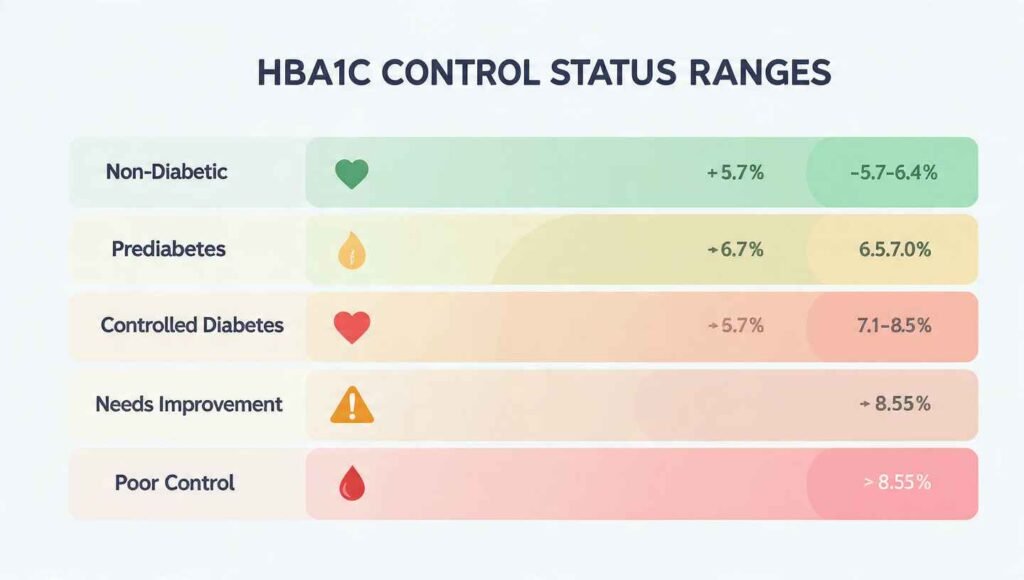
< 5.7% – Non-Diabetic Range
- Normal glucose metabolism
- Low risk of diabetes
- Focus on prevention and healthy lifestyle
5.7% – 6.4% – Prediabetes Range
- Early warning stage
- High risk of developing type 2 diabetes
- Lifestyle changes can reverse progression
6.5% – 7.0% – Controlled Diabetes
- Acceptable control for many adults
- Risk of complications is lower
- Consistency is key
7.1% – 8.5% – Needs Improvement
- Suboptimal glucose control
- Higher risk of complications
- Dietary and lifestyle review required
> 8.5% – Poor Control
- Significantly elevated glucose exposure
- High risk of long-term complications
- Medical consultation strongly recommended
These ranges are automatically displayed in the results section, making interpretation effortless.
Confidence Level: How Reliable Is Your Estimated HbA1c?
An estimated HbA1c value is only as reliable as the quality and duration of the blood glucose data used to calculate it. Blood sugar levels naturally fluctuate from day to day due to meals, physical activity, stress, illness, sleep patterns, and medication changes. For this reason, not all estimated HbA1c results carry the same level of confidence.
To help users interpret their results correctly, the Estimated HbA1c Calculator includes a confidence level indicator based on the number of days of glucose data entered. This feature improves transparency and prevents over-interpretation of short-term data.

🔴 Low Confidence – Less Than 14 Days of Data
When glucose readings cover fewer than 14 days, the estimated HbA1c is considered low confidence.
At this stage:
- Blood glucose patterns may not be stable
- Temporary factors (illness, travel, stress, dietary changes) can heavily influence results
- The estimate may not reflect true long-term glucose exposure
How to use this result:
A low-confidence estimate should be viewed as a rough early signal, not a conclusion. It can help raise awareness but should never be used alone to judge diabetes control.
Recommendation:
Continue monitoring blood glucose consistently and aim to collect at least 14–30 days of data for a more reliable estimate.
🟡 Moderate Confidence – 14 to 29 Days of Data
When glucose readings span two to four weeks, the calculator provides a moderate confidence estimate.
At this level:
- Daily variations begin to balance out
- Patterns in fasting and post-meal glucose become clearer
- The estimated HbA1c becomes more representative of actual control
How to use this result:
A moderate-confidence estimate is useful for:
- Monitoring short-term improvements or deterioration
- Evaluating the impact of dietary or lifestyle changes
- Preparing for an upcoming laboratory HbA1c test
Recommendation:
Use this estimate as a guidance tool, but confirm long-term control with a laboratory HbA1c test, especially if results are outside the target range.
🟢 High Confidence – 30 Days or More of Data
When glucose readings cover 30 days or more, the estimated HbA1c reaches a high confidence level.
At this point:
- Short-term fluctuations are averaged out
- The estimate closely reflects long-term glucose exposure
- Trends become more reliable and meaningful
How to use this result:
A high-confidence estimate is ideal for:
- Tracking long-term glycemic trends
- Assessing consistency of blood sugar control
- Supporting informed discussions with healthcare providers
Recommendation:
Even with high confidence, this estimate should complement—not replace—laboratory HbA1c testing. Regular lab tests remain essential for medical decision-making.
Why Confidence Level Matters
Without a confidence indicator, users may incorrectly assume that all estimated HbA1c values are equally accurate. By clearly showing the confidence level, the calculator:
- Prevents misinterpretation of limited data
- Encourages better glucose monitoring habits
- Builds trust through transparency
- Promotes responsible use of digital health tools
This approach ensures that users understand not just their result, but also how much reliance they should place on it.
| Data Duration | Confidence Level |
| < 14 days | 🔴 Low |
| 14–29 days | 🟡 Moderate |
| ≥ 30 days | 🟢 High |
This transparency builds trust and helps users understand how much weight to give their result.
Estimated HbA1c Calculator vs Laboratory HbA1c Test
| Feature | Estimated HbA1c Calculator | Lab HbA1c Test |
| Uses home glucose data | ✅ | ❌ |
| Shows trends between tests | ✅ | ❌ |
| Diagnostic accuracy | ❌ | ✅ |
| Immediate feedback | ✅ | ❌ |
| Medical gold standard | ❌ | ✅ |
The Estimated HbA1c Calculator and the laboratory HbA1c test serve different but complementary purposes in diabetes care.
The Estimated HbA1c Calculator uses home blood glucose readings (fasting, post-meal, and random values) to give an approximate picture of long-term blood sugar control. Because it relies on self-monitored data, it is especially useful for:
- Tracking trends between lab tests
- Understanding how daily eating habits affect HbA1c
- Getting immediate feedback without waiting weeks or months
However, because it is an estimation, it cannot be used for diagnosis or medical decision-making.
On the other hand, the laboratory HbA1c test measures glycated hemoglobin directly from a blood sample using standardized medical equipment. This makes it the medical gold standard for:
- Diagnosing diabetes and prediabetes
- Confirming long-term glycemic control
- Guiding medication and treatment decisions
The best approach is not choosing one over the other, but using both together. The estimated HbA1c calculator helps you monitor progress regularly, while the lab HbA1c test confirms accuracy and guides medical care.
Best approach:
Use the calculator for ongoing awareness, and confirm with laboratory testing every 3 months.
Who Should Use an Estimated HbA1c Calculator?

This tool is ideal for:
- People with type 2 diabetes
- Individuals with prediabetes
- Newly diagnosed patients
- People adjusting diet or exercise
- Anyone tracking glucose regularly at home
Even non-diabetic individuals can use it for preventive insight.
Key Features of Our Estimated HbA1c Calculator
The calculator you’ve developed includes several advanced yet user-friendly features:
- Multiple glucose input types (fasting, post-meal, random)
- Accepts real-life, imperfect data
- Unit conversion (mg/dL ↔ mmol/L)
- Data duration–based confidence indicator
- HbA1c shown as a range
- Clear control status table
- Educational guidance tailored to results
- Clean, minimal, diabetes-friendly UI
- Transparent medical disclaimer
These features make it more credible and more helpful than simple single-value calculators.
How This Calculator Helps Improve HbA1c Naturally
When users see the direct connection between daily glucose and HbA1c, behavior changes naturally.
Small improvements that matter:
- Reducing glycemic load at meals
- Controlling portion size
- Improving meal timing
- Increasing daily physical activity
- Managing stress and sleep
Even a 0.5–1.0% reduction in HbA1c can significantly reduce complication risk.
Limitations and Important Medical Disclaimer
⚠️ This calculator:
- Does not diagnose diabetes
- Does not replace laboratory HbA1c testing
- Should not be used to adjust medication
- May be less accurate in conditions like anemia, pregnancy, or recent blood loss
Always consult a healthcare professional for medical decisions.
Frequently Asked Questions (FAQs)
How often should I use the estimated HbA1c calculator?
Every 2–4 weeks for trend monitoring.
Why does my estimate differ from lab HbA1c?
Biological variation, data duration, and glucose variability can cause differences.
Is fasting glucose alone enough?
No. Including post-meal readings improves accuracy significantly.
Conclusion – A Smarter Way to Monitor Long-Term Blood Sugar
The Estimated HbA1c Calculator is a powerful educational tool that helps bridge the gap between daily glucose monitoring and long-term diabetes control. While it does not replace laboratory testing, it empowers users with awareness, understanding, and motivation.
By combining multiple glucose readings, clear interpretation, confidence indicators, and user-friendly design, this calculator transforms raw numbers into meaningful health insights. Used wisely, it can support better decisions, healthier habits, and improved outcomes over time.
👉 Use the calculator regularly, confirm results with lab tests, and make informed lifestyle choices—because better control starts with better understanding.
If you want to control the diabetes by using 7-day diabetic meal planning calulcator, then read the Article 7-day diabetic meal planning calculator-Smart, Simple and Science based Meal Planning