
Roti is one of the most common staple foods in South Asia, particularly in countries like Pakistan, India, and Bangladesh. For many households, meals without roti feel incomplete. However, for people with diabetes, roti can become a point of concern. Understanding how much roti should a diabetic eat per meal and its effects on blood sugar, which type of roti is healthier, and what the ideal serving size is, can help diabetics enjoy this staple food without compromising their health. In this article, we will explore everything you need to know about roti and diabetes, including glycemic load, portion control, and best choices for diabetic patients.
Table of Contents
1. How Roti Affects Blood Sugar
Roti is primarily made from flour, which is rich in carbohydrates. When carbohydrates are consumed, they are broken down into glucose, which enters the bloodstream. This glucose causes a rise in blood sugar levels.
The degree of this rise depends on several factors:
- The type of flour used
- The fiber content
- The method of preparation
- The portion size
Simply put, the more carbohydrates in the roti, the higher the glucose release into the blood.
2. The Role of Carbohydrates in Diabetes
Carbohydrates are an essential source of energy. However, for people with diabetes, too many carbohydrates at once can cause rapid spikes in blood sugar.
- Refined flour (maida): Quick-digesting carbs that raise blood sugar rapidly
- Whole grains and legumes: Slow-digesting carbs that release glucose gradually
Choosing the right type of flour and controlling portions can significantly reduce blood sugar spikes.
3. Understanding Glycemic Index (GI)
The glycemic index measures how quickly a carbohydrate-containing food raises blood sugar compared to pure glucose.
- High-GI foods: Cause rapid spikes in blood sugar
Example: White flour roti, refined tandoori roti - Low-GI foods: Raise blood sugar slowly and steadily
Example: Bajra, jowar, ragi, or besan roti
However, glycemic index alone is not sufficient. We must also consider glycemic load for portion control.
4. Glycemic Load: The Key to Serving Size
Glycemic load (GL) takes into account both:
- The glycemic index of the food
- The amount of carbohydrates consumed
Formula:
GL = (Glycemic Index × Carbohydrate Content in grams) ÷ 100
GL Categories:
- Low GL: 1–10
- Medium GL: 11–20
- High GL: 21 and above
Even a low-GI roti can raise blood sugar if consumed in large quantities, making serving size critical.
For wheat to sugar reality calculator and Glycemic load read this article Post 3: The Glycemic Index of Wheat Explained: Why Your Daily Roti May Be Spiking Your Blood Sugar
5. Impact of Roti Preparation Methods
Roti is a daily staple food for millions of people across Pakistan, India, and South Asia. From breakfast to dinner, roti is deeply embedded in our food culture. However, for people living with diabetes or insulin resistance, roti often becomes a confusing and controversial topic. Many diabetics ask: Is roti bad for blood sugar? Can diabetics eat roti daily? How much roti is safe?
The truth is simple but often misunderstood: roti itself is not the enemy. The type of flour, the method of preparation, and most importantly, the portion size, play a critical role in determining how roti affects blood sugar levels.
In this detailed, SEO-optimized guide, we will deeply elaborate on how different roti preparation methods impact glycemic load, and how much roti a diabetic should ideally eat per meal to maintain stable blood glucose levels. This article is written in simple, conversational language, backed by nutritional logic, and tailored especially for South Asian diets.
Understanding Glycemic Load Before Talking About Roti
Before diving into preparation methods and serving sizes, it is essential to understand one concept clearly: glycemic load (GL).
- Glycemic Index (GI) tells how fast a food raises blood sugar.
- Glycemic Load (GL) tells how much blood sugar rises based on both GI and carbohydrate quantity.
👉 This means even a medium-GI food can spike blood sugar if eaten in large portions.
Roti usually has a moderate GI, but depending on how it is cooked and how much you eat, its glycemic load can shift from moderate to very high.
Why Preparation Method Matters More Than Most People Think
Most people assume that all rotis affect blood sugar in the same way. This is a big misconception. The preparation method can significantly alter:
- Carbohydrate absorption speed
- Fat content
- Calorie density
- Insulin response
Let’s break this down step by step.
Plain Roti and Blood Sugar Response (Moderate Glycemic Load)
Plain roti, made with whole wheat atta and cooked without oil or ghee, is the least harmful form of roti for diabetics.
Why Plain Roti Is Better:
- Contains complex carbohydrates
- Has natural fiber (especially if stone-ground atta is used)
- Slower digestion compared to refined flour
- No added fats to accelerate glucose absorption
Glycemic Impact:
- Glycemic Load: Moderate
- Causes a gradual rise in blood sugar, not an immediate spike
- Safer when eaten in small portions
Best Practices:
- Use whole wheat or multigrain atta
- Avoid refined flour (maida)
- Pair with protein or fiber-rich foods
✅ Example:
Plain roti + dal + sabzi = much better blood sugar control than roti alone.
Fried Roti and Paratha: Why Glycemic Load Becomes High
When roti is turned into a paratha, the story changes completely.
What Changes When Oil or Ghee Is Added?
- Fat increases calorie density
- Fat improves taste, leading to overconsumption
- Oil increases palatability, encouraging larger portions
- Combined fat + carbs trigger higher insulin demand
Glycemic Impact:
- High glycemic load
- Causes faster and higher blood sugar spikes
- Difficult for diabetics to metabolize efficiently
Many people believe that fat “slows sugar absorption,” but this is only partially true. In real meals, fat + refined carbs together worsen insulin resistance over time.
❌ Regular consumption of paratha can:
- Raise fasting blood sugar
- Increase post-meal glucose
- Lead to weight gain and poor control
Stuffed Roti: Why It Has a Very High Glycemic Load
Stuffed rotis such as aloo paratha, paneer paratha, qeema roti, or cheese-filled rotis are extremely common—but also extremely problematic for diabetics.
Why Stuffed Rotis Are Risky:
- Double carbohydrate load (roti + filling)
- Potato and paneer fillings are highly insulinogenic
- Often cooked with extra oil or butter
- Large portion size is the norm
Glycemic Impact:
- Very high glycemic load
- Sharp blood sugar spikes within 60–90 minutes
- Difficult to control even with medication
👉 Even meat-filled rotis can spike sugar if:
- Flour quantity is high
- Oil is excessive
- Portion size is large
❌ For diabetics, stuffed rotis should be:
- Occasional at best
- Avoided during periods of poor sugar control
Cooking Technique: Tawa vs Oil-Fried Methods
Even small differences in cooking style matter.
- Dry tawa roti → Lower GL
- Oil-brushed roti → Higher GL
- Deep-fried or layered paratha → Very high GL
Repeated brushing with oil during cooking adds hidden calories that many people don’t account for.
Impact of Preparation Methods on Blood Sugar (Detailed Elaboration)
Let’s summarize the impact clearly:
Plain Roti
- Moderate GL
- Best option for diabetics
- Requires portion control
Fried Roti / Paratha
- High GL
- Increased calories and insulin demand
- Leads to sugar spikes
Stuffed Roti
- Very High GL
- Combines carbs + fat + excess calories
- Strongly linked with post-meal hyperglycemia
🔴 Key Point:
The more oil and starch you add, the higher and faster your blood sugar will rise.
6.How Much Roti Should a Diabetic Eat Per Meal? (Ideal Serving Size Explained)
This is one of the most critical questions for diabetes management.
Even the healthiest roti can become harmful if eaten in excess.
Understanding Roti Weight and Serving Size
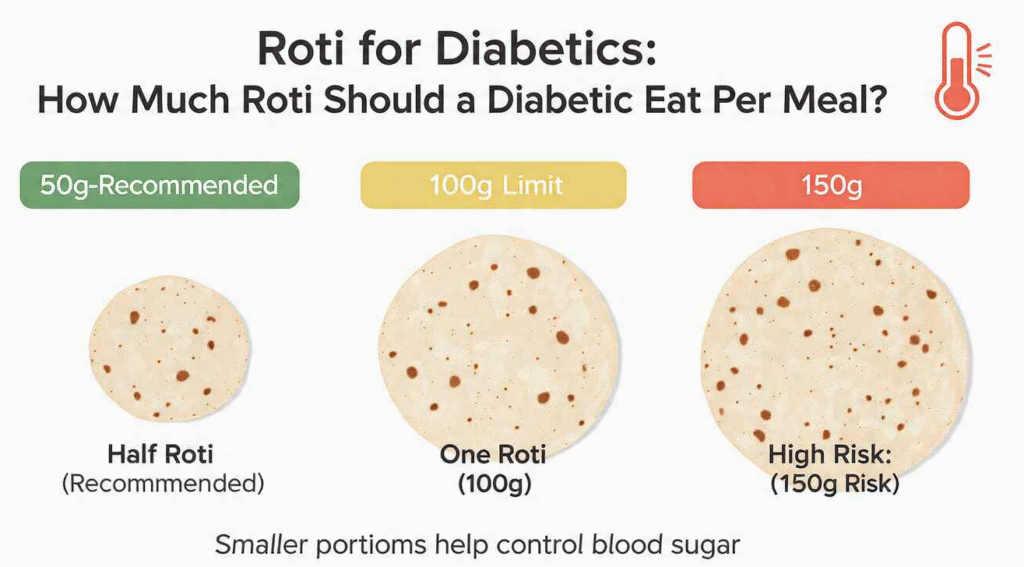
A medium-sized whole wheat roti usually weighs around 90–100 grams.
Let’s analyze common serving sizes:
50 g Roti (Half Roti): Low Glycemic Load – Safest Option
Why 50 g Is Ideal:
- Lower carbohydrate intake
- Minimal glucose spike
- Easier insulin response
- Better post-meal sugar control
Best For:
- Type 2 diabetics
- Pre-diabetics
- People with insulin resistance
- Weight management
✅ Especially effective when paired with:
- Lentils
- Vegetables
- Yogurt (dahi)
- Protein sources
100 g Roti (One Roti): Medium to High GL – Eat with Caution
What Happens at 100 g:
- Moderate carbohydrate load
- Sugar rise depends on:
- Activity level
- Insulin sensitivity
- Meal combination
When It Can Be Acceptable:
- If paired with high protein
- If vegetables are abundant
- If oil usage is minimal
⚠️ Should be avoided:
- At dinner
- When blood sugar is already high
- Without protein or fiber
150 g Roti (One and a Half Roti): High GL – Not Recommended
Why This Is Risky:
- Excess carbohydrate intake
- High glycemic load
- Strong blood sugar spike
- Increased insulin requirement
❌ Regular consumption can lead to:
- Poor HbA1c control
- Weight gain
- Increased medication dependency
For most diabetics, 150 g roti per meal is not advisable.
7.Why Pairing Roti With Protein and Fiber Is Essential
Eating roti alone is one of the biggest mistakes diabetics make.
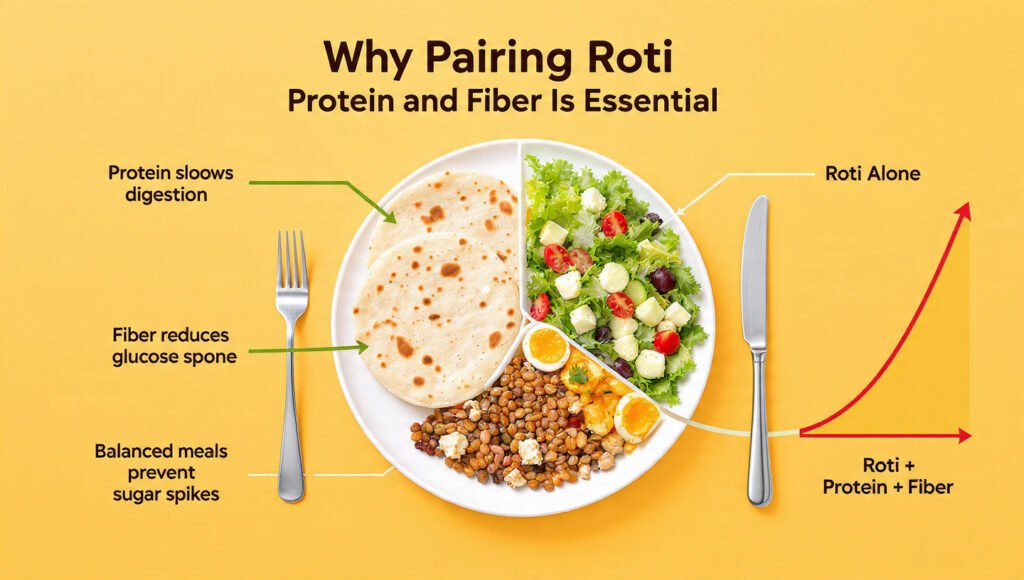
Protein Helps By:
- Slowing glucose absorption
- Improving insulin response
- Reducing hunger
Fiber Helps By:
- Delaying digestion
- Flattening sugar spikes
- Improving gut health
✅ Best combinations:
- Roti + dal
- Roti + sabzi
- Roti + dahi
- Roti + eggs or lean meat
8.Timing of Roti Consumption Matters
- Breakfast: Small portion acceptable
- Lunch: Best time to eat roti
- Dinner: Minimize or avoid if sugars are unstable
Night-time insulin sensitivity is lower, so even small portions can spike sugar at dinner.
9. Glycemic Load of Different Rotis (Comparison Table)
Here’s a comparison of 15 common types of roti by serving size:
| Type of Roti | 50 g (Half Roti) | 100 g (One Roti) | 150 g (1.5 Roti) |
| Wheat roti | 17 | 34 | 51 (High) |
| Jowar roti | 15 | 30 | 45 (High) |
| Tandoori roti | 14 | 28 | 42 (High) |
| Whole-wheat (chakki) roti | 13 | 26 | 39 (High) |
| Potato naan | 13 | 26 | 39 (High) |
| Keema naan | 12 | 24 | 36 |
| Barley roti | 12 | 24 | 36 |
| Oats roti | 11 | 22 | 33 |
| Corn roti | 11 | 22 | 33 |
| Potato-stuffed roti | 11 | 22 | 33 |
| Bajra roti | 10 | 20 | 30 |
| Ragi roti | 10 | 21 | 32 |
| Missi roti | 9 | 19 | 28 |
| Multigrain roti | 9 | 18 | 27 |
| Besan roti | 5 | 10 | 15 |
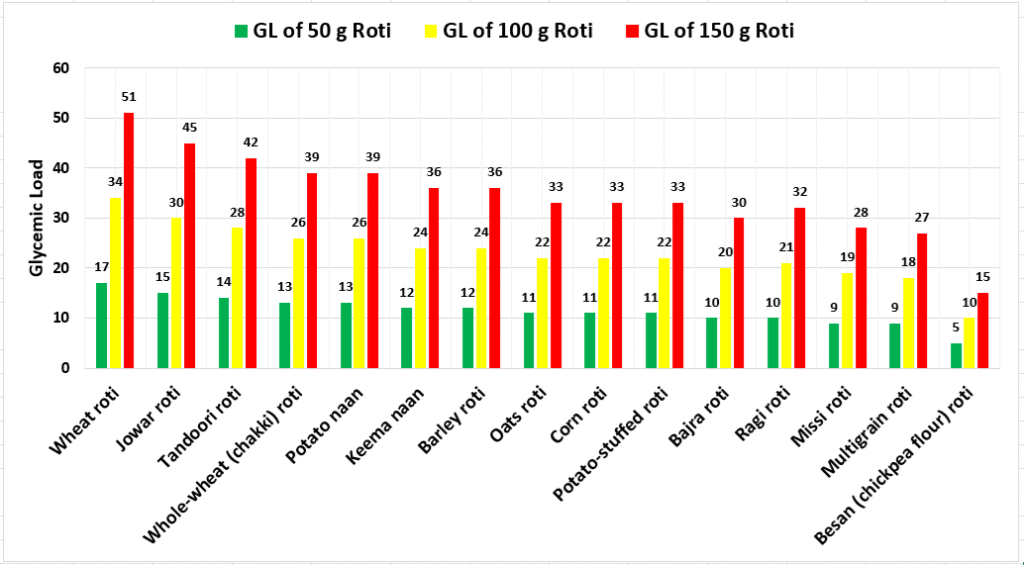
This glycemic load comparison table clearly shows how both the type of roti and its serving size influence blood sugar levels. Rather than labeling foods as simply “good” or “bad,” the data highlights a more practical truth: portion size is the most critical factor for blood sugar control, especially for people with diabetes.
Glycemic load (GL) combines the quality of carbohydrates (glycemic index) with the quantity consumed, making it a far more realistic indicator of how food affects blood glucose. According to standard classification, a GL of 1–10 is low, 11–20 is medium, and 21 or above is high. The table demonstrates that many rotis shift rapidly from medium to high glycemic load as serving size increases from half to one full roti.
Traditional wheat-based rotis, including wheat roti, tandoori roti, and chakki roti, mostly fall into the medium GL range at half serving but quickly move into the high GL range at one roti or more. This explains why many people experience blood sugar spikes despite eating home-cooked meals.
Stuffed and refined options such as potato naan and potato-stuffed roti show even higher glycemic loads due to increased carbohydrate density. Even protein-containing options like keema naan become high glycemic when portion size increases, proving that protein alone cannot offset excess carbohydrates.
Millet-based rotis—such as jowar, bajra, and ragi—perform better, especially at smaller portions. Among these, bajra and ragi roti reach the low glycemic load range at half serving, but still become high GL when consumed in larger amounts. Oats, corn, and barley rotis offer moderate benefits but remain portion-sensitive.
The most favorable option in the entire table is besan (chickpea flour) roti. It stays in the low glycemic load range even at one full roti and only reaches medium GL at one and a half servings. Missi roti and multigrain roti also show balanced glycemic behavior due to higher fiber and protein content.
The key takeaway is simple yet powerful: no roti is completely safe in large quantities, and no roti is harmful when eaten in controlled portions. For diabetics, limiting intake to 50 grams (half roti) and choosing besan, multigrain, missi, or bajra roti, preferably with protein or yogurt, can significantly improve blood sugar control.
10. Best Rotis for Diabetics
Based on the glycemic load table:
Low-GL Options (50 g serving)
- Besan roti
- Multigrain roti
- Missi roti
- Bajra roti
- Ragi roti
Rotis to Limit or Avoid
- White flour / refined roti
- Potato-stuffed roti
- Fried paratha or oil-heavy rotis
11. Tips for Eating Roti Safely as a Diabetic
- Limit portion to half roti per meal
- Choose whole-grain or legume-based flours
- Pair with yogurt, lentils, vegetables, or protein
- Avoid multiple rotis in a single meal
- Avoid starchy or fried fillings
Proper pairing slows carbohydrate absorption and reduces blood sugar spikes.
12. Roti vs Rice for Diabetics
Many people wonder whether roti or rice is safer for diabetics. In general:
- Roti has a lower glycemic load per serving than rice
- Whole-grain rotis digest slower than white rice
- Portion control is still crucial to prevent spikes
Tip: Always measure serving sizes and pair carbohydrates with protein and fiber.
13. Common Myths About Roti and Diabetes
Myth 1: Brown roti can be eaten freely
➡️ Reality: Portion still matters
Myth 2: Paratha is fine if homemade
➡️ Reality: Oil quantity matters more than source
Myth 3: Stuffed roti is healthy if vegetables are used
➡️ Reality: Carb overload still applies
Practical Tips for Diabetics Who Love Roti
- Use multigrain atta
- Limit oil strictly
- Reduce roti size gradually
- Eat slowly and mindfully
- Monitor post-meal blood sugar
14. Frequently Asked Questions (FAQs)
Q1: How much roti should a diabetic eat per meal?
A: Ideally, half a roti (50 g) per meal to keep glycemic load low.
Q2: Can diabetics eat one roti daily?
A: Yes, but ideally split across meals or paired with protein/fiber.
Q3: Which type of roti is best for diabetes?
A: Besan, multigrain, missi, bajra, or ragi roti are ideal due to low glycemic load.
Q4: Does roti spike blood sugar immediately?
A: Yes, refined or large portions can spike blood sugar rapidly.
Q5: Can roti be eaten with lentils or yogurt?
A: Yes, pairing roti with protein or fiber-rich foods slows carbohydrate absorption and stabilizes blood sugar.
15. Conclusion
Roti is not off-limits for diabetic patients, but portion size, type of flour, and preparation method play critical roles in managing blood sugar. The glycemic load of roti is the best indicator of how it affects blood sugar.
- Half roti (50 g) of besan, multigrain, missi, bajra, or ragi is safe and recommended
- Avoid fried or stuffed rotis and limit white flour rotis
- Always pair roti with fiber or protein-rich foods for optimal blood sugar control
By following these guidelines, diabetics can enjoy roti as part of a balanced and blood sugar-friendly diet.